
Lucretius: De Rerum Natura Book 3


Lucretius: De Rerum Natura Book 3
Regular price
Checking stock...
Regular price
Checking stock...
Summary
The De Rerum Natura of Lucretius is a sustained and impassioned protest against religious superstition and irrationality. The poem takes the form of a detailed exposition of Epicurean physical theory - an extreme materialism designed to remove and discredit popular fears of the gods, death and an afterlife.
The feel-good place to buy books
- Free delivery in Ireland
- Supporting authors with AuthorSHARE
- 100% recyclable packaging
- Proud to be a B Corp – A Business for good
- Buy-back with Ziffit
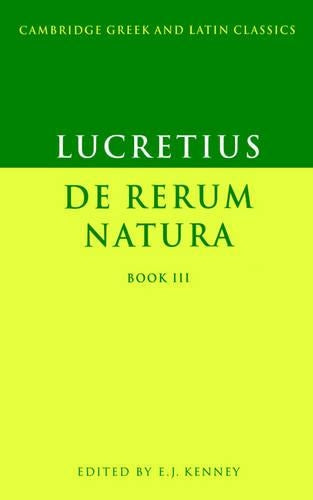
Lucretius: De Rerum Natura Book 3 by Titus Lucretius Carus
The De Rerum Natura of Lucretius is a sustained and impassioned protest against religious superstition and irrationality. The poem takes the form of a detailed exposition of Epicurean physical theory - an extreme materialism designed to remove and discredit popular fears of the gods, death and an afterlife. Book III is generally accepted to be the finest in the whole poem; Lucretius argues there that the soul is as mortal as the body and shows that human response to the fact of mortality and death can be at once rational, dignified and liberating. Professor Kenney's commentary is the first to give proper critical emphasis to the techniques and intentions of Lucretius' poetry; it can be read with profit by all students of Latin from senior school level upwards.
'This is a thoroughly professional commentary, long overdue, certainly the soundest available guide for anyone beginning to read Lucretius, and all written with a brevity that comes near to wit' David West, Journal of Roman Studies
'The result … is excitingly successful … Somehow [the editor] has managed … to talk about the important matters, to ask the right questions, to admit uncertainty, and to elucidate the purport of individual paragraphs and yet not to lose sight of their particular function within the Book as a whole.' J. P. Elder, American Journal of Philosophy
'Für die grammatisch-stilistische Einzelerklärung ist K.s Kommentar vorzüglich; hier leistet er nicht selten Besseres als Bailey. Dem mit L.'Sprache unvertrauten Anfänger wird er ein nützlicher Helfer sein; die Mittel und die Kunst der Darstellung … werden sachkundig erläutert.' Konrad Müller, Gnomon
'The result … is excitingly successful … Somehow [the editor] has managed … to talk about the important matters, to ask the right questions, to admit uncertainty, and to elucidate the purport of individual paragraphs and yet not to lose sight of their particular function within the Book as a whole.' J. P. Elder, American Journal of Philosophy
'Für die grammatisch-stilistische Einzelerklärung ist K.s Kommentar vorzüglich; hier leistet er nicht selten Besseres als Bailey. Dem mit L.'Sprache unvertrauten Anfänger wird er ein nützlicher Helfer sein; die Mittel und die Kunst der Darstellung … werden sachkundig erläutert.' Konrad Müller, Gnomon
TITUS LUCRETIUS CARUS, the Roman philosopher-poet and author of one work, De rerum natura (On the Nature of Things), was born around 95 BCE. Almost nothing is known of his life; even his birth and death dates remain open to conjecture. He may have been a member of the aristocratic family of the Lucretii, or else a freedman attached to the Lucretii family. The only uncontested fact about Lucretius's life has to do with his friendship with, or dependence upon, Gaius Memmius, the aristocratic patron of the poets Gaius Valerius Catullus and Gaius Helvius Cinna, for it is Memmius to whom Lucretius dedicates his poem. St. Jerome makes the extravagant claim that Lucretius had been poisoned by a love-philter, and that he composed his 7,400-line poem during his lucid intervals. (This apocryphal tale may be based on Lucretius's attack on erotic passion in book 4.) An anonymous life of Lucretius attached to an early edition of On the Nature of Things indicates that Lucretius was an intimate of Cicero, Cicero's friend Atticus, and Marcus Junius Brutus (the tyrranicide). This life is of doubtful authenticity; the only real connection with Cicero comes with Cicero's implication, in a letter to his brother, Quintus, that he has read the work, which was not published until after Lucretius's death. With his great poem, Lucretius took up the cause of Epicureanism at Rome, extolling its founder, Epicurus of Athens (341-271 B.C.E.), as our father, the revealer of truth, the giver of fatherly precepts. Lucretius saw himself as a strict follower of the master, although he sometimes avoided the more abstruse points of Epicurus's argument and substituted for the master's dry prose a wealth of vivid observations and imagery which mark him as a true poet, and which made Epicureanism more appealing to a wider audience. Much of Lucretius's poem, in six books, is concerned with detailing the atomic view of the universe. This includes discussion of the mechanical laws of nature, the mortality of the soul, and the moral theory that pleasure (meaning largely the absence of pain) is the goal of life. At the root of the discussion is the idea that atoms both eternal and infinite in number make up the physical universe, including the souls of humankind. However, while the universe is material, it is not deterministic: the swerve of atoms, a concept developed by Epicurus, accounts both for chance and for human free will. One of the benefits of Epicureanism came with its abolition of the superstitious fear that the gods intervene in human affairs, and that the soul is subject to punishment in an afterlife. Since the soul, composed of extremely fine atoms, dissolves with the death of the body, humankind need not fear an eternity of pain and suffering. Lucretius was taken up enthusiastically by educated Romans. But with the rise of Christianity, he was condemned for his denial of the soul's immortality and for teaching that pleasure is the end of life. Following a long period of neglect, Lucretius's work once more became a profound source of secular ideas, beginning with the revival of classical learning during the Renaissance. Lucretius died about 55 BCE.
| SKU | Unavailable |
| ISBN 13 | 9780521291774 |
| ISBN 10 | 0521291771 |
| Title | Lucretius: De Rerum Natura Book 3 |
| Author | Titus Lucretius Carus |
| Series | Cambridge Greek And Latin Classics |
| Condition | Unavailable |
| Binding Type | Paperback |
| Publisher | Cambridge University Press |
| Year published | 1977-01-27 |
| Number of pages | 272 |
| Cover note | Book picture is for illustrative purposes only, actual binding, cover or edition may vary. |
| Note | Unavailable |