
Medieval Women and Urban Justice


Summary
The feel-good place to buy books
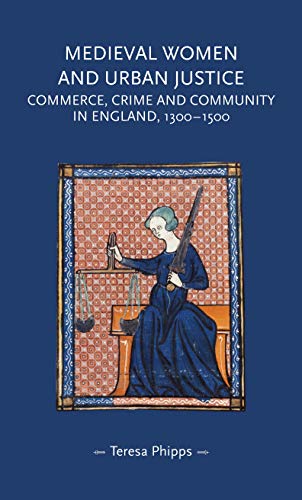
Medieval Women and Urban Justice by Teresa Phipps
This book provides a detailed analysis of women's involvement in litigation and other legal actions within their local communities in late-medieval England. It draws upon the rich records of three English towns - Nottingham, Chester and Winchester - and their courts to bring to life the experiences of hundreds of women within the systems of local justice. Through comparison of the records of three towns, and of women's roles in different types of legal action, the book reveals the complex ways in which individual women's legal status could vary according to their marital status, different types of plea and the town that they lived in. At this lowest level of medieval law, women's status was malleable, making each woman's experience of justice unique.'Medieval town life has been heralded for offering women increased opportunities for economic activity and social advancementHowever, the study of women in urban judicial courts complicates this picture by reporting occasions in which women violated principles of peace and equity or were themselves victims of violation. Phipps (Swansea Univ., UK) samples the legal records of the medium-sized English towns Nottingham, Chester, and Winchester, showing them to be rich sources of social history for better understanding urban justice. The cases indicate that women’s legal action was not defined primarily or solely by gender, as they were perpetrators or victims of the same kinds of misbehavior as men. Although marriage technically transferred a woman’s legal responsibility to her husband—the concept of coverture—town courts held flexible ideas about how to apply this at least until the mid-15th century, not hesitating to find a woman fully responsible for some crimes. The study of debt litigation, regulation of work and trade, public disorder, and verbal disturbances sheds light on women’s roles in urban settings, where justice and peacekeeping were seriously pursued for the profit and well-being of all within their walls.'
--L. C. Attreed, College of the Holy Cross
Summing Up: Recommended. Lower-division undergraduates through faculty.
'Dr Phipps’ book is undoubtedly a valuable contribution to the scholarship in this field and will appeal to a wide readership.'
Transactions of the Historic Society of Lancashire and Cheshire, Dr Shaun D. McGuinness
'In this meticulously researched book, Teresa Phipps surfaces the working lives of women in three medieval English towns—Nottingham, Chester, and Winchester—through a quantitative and qualitative analysis of their appearances in legal records, often in the context of commercial disputes.'
Speculum
| SKU | Unavailable |
| ISBN 13 | 9781526171795 |
| ISBN 10 | 1526171791 |
| Title | Medieval Women and Urban Justice |
| Author | Teresa Phipps |
| Series | Gender In History |
| Condition | Unavailable |
| Binding Type | Paperback |
| Publisher | Manchester University Press |
| Year published | 2023-05-30 |
| Number of pages | 232 |
| Cover note | Book picture is for illustrative purposes only, actual binding, cover or edition may vary. |
| Note | Unavailable |