


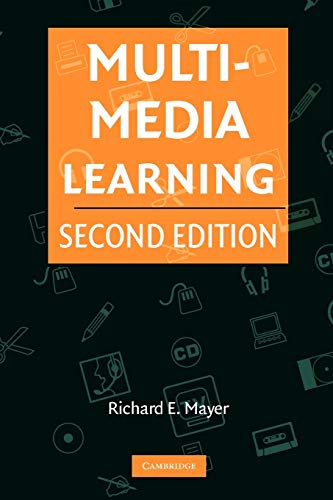
Multimedia Learning by Richard E Mayer
Although verbal learning offers a powerful tool, Mayer explores ways of going beyond the purely verbal. Recent advances in graphics technology and information technology have prompted new efforts to understand the potential of multimedia learning as a means of promoting human understanding. In this second edition, Mayer includes double the number of experimental comparisons, 6 new principles - signalling, segmenting, pertaining, personalization, voice and image principles. The 12 principles of multimedia instructional design have been reorganized into three sections - reducing extraneous processing, managing essential processing and fostering generative processing. Finally an indication of the maturity of the field is that the second edition highlights boundary conditions for each principle research-based constraints on when a principle is likely or not likely to apply. The boundary conditions are interpreted in terms of the cognitive theory of multimedia learning, and help to enrich theories of multimedia learning.
"..The material is well structured and goes into succeeding levels of detail to describe what works and what doesn’t. Cognitive aspects of how learning is delivered are thoroughly presented, using many charts and graphics to provide alternate means of viewing the text data. The text relies on extensive research performed by the author and other notable cognitive psychologists and instructional designers in the field. The book can serve as an excellent text for upper-level undergraduate and graduate courses in instructional design. It can also be used by professionals in the field, as a reference guide to what may be new cognitive research applied to the area of multimedia learning." --Bernice Glenn, Reviews.com (Computing Reviews)
Richard E. Mayer is Professor of Psychology at the University of California, Santa Barbara, where he has served since 1975. He is the author of Multimedia Learning (Cambridge University Press, 2001) and editor of The Cambridge Handbook of Multimedia Learning (Cambridge University Press, 2005). In 2008 he received the American Psychological Association's Distinguished Contributions of Applications of Psychology to Education and Training Award.
| SKU | Unavailable |
| ISBN 13 | 9780521735353 |
| ISBN 10 | 0521735351 |
| Title | Multimedia Learning |
| Author | Richard E Mayer |
| Condition | Unavailable |
| Binding Type | Paperback |
| Publisher | Cambridge University Press |
| Year published | 2009-01-12 |
| Number of pages | 320 |
| Cover note | Book picture is for illustrative purposes only, actual binding, cover or edition may vary. |
| Note | Unavailable |