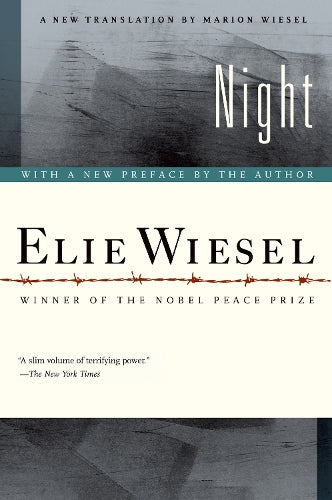
Night by Elie Wiesel

Night by Elie Wiesel

Regular price
Checking stock...
Regular price
Checking stock...
Proud to be B-Corp

Our business meets the highest standards of verified social and environmental performance, public transparency and legal accountability to balance profit and purpose. In short, we care about people and the planet.

The feel-good place to buy books
  • Free delivery in Ireland
  • Supporting authors with AuthorSHARE
  • 100% recyclable packaging
  • Proud to be a B Corp – A Business for good
  • Buy-back with Ziffit

Night by Elie Wiesel

A memorial edition of Elie Wiesel's seminal memoir of surviving the Nazi death camps, with tributes by President Obama and Samantha Power

When Elie Wiesel died in July 2016, the White House issued a memorial statement in which President Barack Obama called him the conscience of the world. The whole of the president's eloquent tribute will appear as a foreword to this memorial edition of Night. Like millions of admirers, I first came to know Elie through his account of the horror he endured during the Holocaust simply because he was Jewish, wrote the president.

In 1986, when Wiesel received the Nobel Peace Prize, the Norwegian Nobel Committee wrote, Elie Wiesel was rescued from the ashes of Auschwitz after storm and fire had ravaged his life. In time he realized that his life could have purpose: that he was to be a witness, the one who would pass on the account of what had happened so that the dead would not have died in vain and so the living could learn. Night, which has sold millions of copies around the world, is the very embodiment of that conviction. It is written in simple, understated language, yet it is emotionally devastating, never to be forgotten.

Born in the town of Sighet, Transylvania, Wiesel was a teenager when he and his family were deported to Auschwitz and then Buchenwald. Night is the shattering record of his memories of the death of his mother, father, and little sister, Tsipora; the death of his own innocence; and his despair as a deeply observant Jew confronting the absolute evil of man.

Never shall I forget that night, the first night in camp, that turned my life into one long night, writes Wiesel. Never shall I forget . . . even were I condemned to live as long as God Himself. These words are etched into the wall of the Holocaust Memorial Museum in Washington. Far more than a chronicle of the sadistic realm of the camps, Night also addresses many of the philosophical and personal questions implicit in any serious consideration of the Holocaust.

In addition to tributes from President Obama and Samantha Powers, this memorial edition of Night includes the unpublished text of a speech that Wiesel delivered before the United Nations General Assembly on the sixtieth anniversary of the liberation of Auschwitz, entitled Will the World Ever Know. These remarks powerfully resonate with Night and with subsequent acts of genocide.

Born in Sighet, Romania, Elie Wiesel was the son of a grocer. In 1944 he and his family were deported, along with other Jews, to the Nazi death camps. His father died in Buchenwald and his mother and his younger sisters at Auschwitz. (Wiesel did not learn until after the war that his older sisters had also survived.) Upon liberation from the camps, Wiesel boarded a train for Western Europe with other orphans. The train arrived in France, where he chose to remain. He settled first in Normandy and later in Paris, where he completed his education at the Sorbonne (from 1948 to 1951). To support himself, he did whatever he could, including tutoring, directing a choir, and translating. Eventually he began working as a reporter for various French and Jewish publications. Emotionally unable at first to write about his experience of the Holocaust, in the mid-1950s the novelist Francois Mauriac urged him to speak out and tell the world of his experiences. The result was La Nuit (1958), later translated as Night (1960), the story of a teenage boy plagued with guilt for having survived the death camps and for questioning his religious faith. Before the book was published, Wiesel had moved to New York (in 1956), where he continued writing and eventually began teaching. He became a naturalized American citizen in 1963, following a long recuperation from a car accident. Since the publication of Night, Wiesel has become a major writer, literary critic, and journalist. As a writer steeped in the Hasidic tradition and concerned with the Holocaust he survived, he has written on the problem of persecution and the meaning of being a Jew. Dawn (1960) is an illuminating document about terrorists in Palestine. In The Accident (1961), Eliezer, a Holocaust survivor, can not seem to escape the past. Other notable works include The Gates of the Forest (1964) and Twilight (1988), which explore the themes of human suffering and a belief in God. Wiesel has received a number of awards and honors for his literary work, including the William and Janice Epstein Fiction Award in 1965, the Jewish Heritage Award in 1966, the Prix Medicis in 1969, and the Prix Livre-International in 1980. As a result of his work in combating human cruelty and in advocating justice, Wiesel was awarded the Nobel Peace Prize in 1986. He has also served as chairman of the U.S. Holocaust Memorial Council and spoke at the dedication of the Holocaust Museum in Washington, D.C., in 1993.
SKU Unavailable
ISBN 13 9780374500016
ISBN 10 0374500010
Title Night
Author Elie Wiesel
Condition Unavailable
Binding Type Paperback
Publisher Hill & Wang Inc.,U.S.
Year published 2006-01-16
Number of pages 144
Cover note Book picture is for illustrative purposes only, actual binding, cover or edition may vary.
Note Unavailable