
Otti Berger: Weaving for Modernist Architecture


Otti Berger: Weaving for Modernist Architecture
Regular price
Checking stock...
Regular price
Checking stock...
Proud to be B-Corp
Our business meets the highest standards of verified social and environmental performance, public transparency and legal accountability to balance profit and purpose. In short, we care about people and the planet.
The feel-good place to buy books
- Free delivery in Ireland
- Supporting authors with AuthorSHARE
- 100% recyclable packaging
- Proud to be a B Corp – A Business for good
- Buy-back with Ziffit
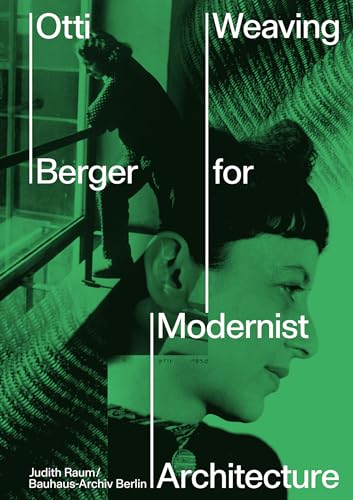
Otti Berger: Weaving for Modernist Architecture by Judith Raum
The Fabric of Modern Architecture Otti Berger created fabrics that fundamentally changed the understanding of what textiles could be and do. A core member of the experimental approach to textiles at the Bauhaus, she also was a female entrepreneur in the frenzied time that was the early 1930s in Berlin. Working closely with architects of the New Objectivity movement such as Lilly Reich, Ludwig Hilberseimer and Hans Scharoun, she designed upholstery and wall tapestries, curtains and floor coverings that responded to novel types of use and production methods, and thereby redefined the relationship between aesthetics and function - with fascinating results. To date Berger's textile work has only been explored in fragments. This book is the first comprehensive study of its complexity and beauty and makes her hitherto unpublished treatise on fabrics and the methodology of textile production accessible. By systematically arranging the fabrics according to their application, Raum's research offers an entirely new perspective on Berger's oeuvre that emphasizes the craftsmanship and entrepreneurial side of her work, and appreciates the largely unrecognized significance of textiles in the history of architecture and design.
OTTI BERGER (1898–1944) was one of the most important textile designers of the 20th century. Born in Zmajevac, in the Austro-Hungarian Empire, present-day Croatia, she studied in Zagreb from 1921–1926 and at the Bauhaus in Dessau from 1927. Leaving her teaching post at the Bauhaus, she set up her own business in Berlin in 1932 to design fabrics for modern interiors throughout Europe. In 1936, she was banned from working due to her Jewish heritage. Attempts to escape to England and the USA failed. She was deported from Croatia to Auschwitz and was murdered there in 1944.
Visual artist and art historian JUDITH RAUM (*1977) has been preoccupied for several years with the Bauhaus textile workshop. Her intensive research in European and North American archives in cooperation with the Bauhaus Archive Berlin, is the first comprehensive study of Berger’s scattered estate.
Visual artist and art historian JUDITH RAUM (*1977) has been preoccupied for several years with the Bauhaus textile workshop. Her intensive research in European and North American archives in cooperation with the Bauhaus Archive Berlin, is the first comprehensive study of Berger’s scattered estate.
| SKU | Unavailable |
| ISBN 13 | 9783775755009 |
| ISBN 10 | 3775755004 |
| Title | Otti Berger: Weaving for Modernist Architecture |
| Author | Judith Raum |
| Condition | Unavailable |
| Binding Type | Hardback |
| Publisher | Hatje Cantz |
| Year published | 2024-04-25 |
| Number of pages | 352 |
| Cover note | Book picture is for illustrative purposes only, actual binding, cover or edition may vary. |
| Note | Unavailable |