
The Problem of Immigration in a Slaveholding Republic


The Problem of Immigration in a Slaveholding Republic
Regular price
Checking stock...
Regular price
Checking stock...
Proud to be B-Corp
Our business meets the highest standards of verified social and environmental performance, public transparency and legal accountability to balance profit and purpose. In short, we care about people and the planet.
The feel-good place to buy books
- Free delivery in Ireland
- Supporting authors with AuthorSHARE
- 100% recyclable packaging
- Proud to be a B Corp – A Business for good
- Buy-back with Ziffit
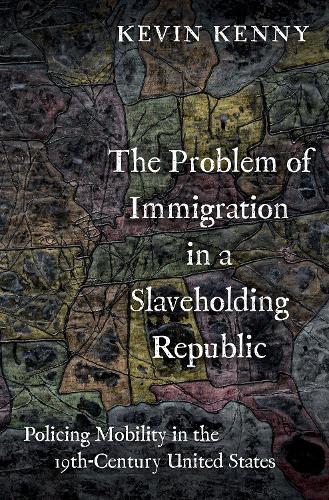
The Problem of Immigration in a Slaveholding Republic by Kevin Kenny
A powerful analysis of how regulation of the movement of enslaved and free black people produced a national immigration policy in the period between the American Revolution and the end of Reconstruction. Today the United States considers immigration a federal matter. Yet, despite America's reputation as a "nation of immigrants," the Constitution is silent on the admission, exclusion, and expulsion of foreigners. Before the Civil War, the federal government played virtually no role in regulating immigration, and states set their own terms for regulating the movement of immigrants, free blacks, and enslaved people. Insisting that it was their right and their obligation to protect the public health and safety, states passed their own laws prohibiting the arrival of foreign convicts, requiring shipmasters to post bonds or pay taxes for passengers who might become public charges, ordering the deportation of immigrant paupers, quarantining passengers who carried contagious diseases, excluding or expelling free blacks, and imprisoning black sailors. To the extent that these laws affected foreigners, they comprised the immigration policy of the United States. Offering an original interpretation of nineteenth-century America, The Problem of Immigration in a Slaveholding Republic argues that the existence, abolition, and legacies of slavery were central to the emergence of a national immigration policy. In the century after the American Revolution, states controlled mobility within and across their borders and set their own rules for community membership. Throughout the antebellum era, defenders of slavery feared that, if Congress gained control over immigration, it could also regulate the movement of free black people and the interstate slave trade. The Civil War and the abolition of slavery removed the political and constitutional obstacles to a national immigration policy, which was first directed at Chinese immigrants. Admission remained the norm for Europeans, but Chinese laborers were excluded through techniques of registration, punishment, and deportation first used against free black people in the antebellum South. To justify these measures, the Supreme Court ruled that immigration authority was inherent in national sovereignty and required no constitutional justification. The federal government continues to control admissions and exclusions today, while some states monitor and punish immigrants, and others offer sanctuary and refuse to act as agents of federal law enforcement. By revealing the tangled origins of border control, incarceration, and deportation, distinguished historian Kevin Kenny sheds light on the history of race and belonging in America, as well as the ongoing tensions between state and federal authority over immigration.
Kenny brings a fresh and insightful look at changing 19th-century immigration law in this crisp legal history.. Based on a close reading of key immigration law cases and other primary sources, this erudite study sheds light on the long and complicated history of immigration law. * Library Journal *
One can't fully understand the origins of US immigration policy without knowing the history of slavery and Native American removal. In this beautifully written book, Kevin Kenny shows how these painful histories laid the groundwork for the barring, policing, detaining, and expelling of immigrants and shaped American understandings of federal plenary power, citizenship, and sovereignty. This book shows why Kenny is one of the most insightful historians of the nineteenth-century United States. * María Cristina García, author of State of Disaster: The Failure of US Migration Policy in an Age of Climate Change *
From Kevin Kenny, eminent scholar in immigration history, comes a timely reminder that slavery once touched every aspect of American life, including border control. He makes a powerful case that today's immigration policies still bear the scars of the slaveholding republic. * Beth Lew-Williams, author of The Chinese Must Go: Violence, Exclusion, and the Making of the Alien in America *
In a bold and sweeping reinterpretation, Kenny convincingly places slavery and its legacy at the heart of the US immigration history. The Problem of Immigration in a Slaveholding Republic is a must read for students of either field. * Sam Erman, author of Almost Citizens: Puerto Rico, the U.S. Constitution, and Empire *
The most comprehensive and penetrating analysis of nineteenth-century US immigration policy that I have read. Kevin Kenny's brilliant reconstruction of the intersecting efforts to police the movement of enslaved, immigrant, and indigenous populations will change the way we think about the history—and the current state—of America's immigration regime. * Gary Gerstle, University of Cambridge *
One can't fully understand the origins of US immigration policy without knowing the history of slavery and Native American removal. In this beautifully written book, Kevin Kenny shows how these painful histories laid the groundwork for the barring, policing, detaining, and expelling of immigrants and shaped American understandings of federal plenary power, citizenship, and sovereignty. This book shows why Kenny is one of the most insightful historians of the nineteenth-century United States. * María Cristina García, author of State of Disaster: The Failure of US Migration Policy in an Age of Climate Change *
From Kevin Kenny, eminent scholar in immigration history, comes a timely reminder that slavery once touched every aspect of American life, including border control. He makes a powerful case that today's immigration policies still bear the scars of the slaveholding republic. * Beth Lew-Williams, author of The Chinese Must Go: Violence, Exclusion, and the Making of the Alien in America *
In a bold and sweeping reinterpretation, Kenny convincingly places slavery and its legacy at the heart of the US immigration history. The Problem of Immigration in a Slaveholding Republic is a must read for students of either field. * Sam Erman, author of Almost Citizens: Puerto Rico, the U.S. Constitution, and Empire *
The most comprehensive and penetrating analysis of nineteenth-century US immigration policy that I have read. Kevin Kenny's brilliant reconstruction of the intersecting efforts to police the movement of enslaved, immigrant, and indigenous populations will change the way we think about the history—and the current state—of America's immigration regime. * Gary Gerstle, University of Cambridge *
Kevin Kenny is Glucksman Professor of History and director of Glucksman Ireland House at New York University. He is the author of Diaspora: A Very Short Introduction (OUP, 2013), The American Irish: A History, and Making Sense of the Molly Maguires (OUP, 1998), among other books. President of the Immigration and Ethnic History Society, Kenny came to the United States as an immigrant in the 1980s.
| SKU | Unavailable |
| ISBN 13 | 9780197580080 |
| ISBN 10 | 0197580084 |
| Title | The Problem of Immigration in a Slaveholding Republic |
| Author | Kevin Kenny |
| Condition | Unavailable |
| Binding Type | Hardback |
| Publisher | Oxford University Press Inc |
| Year published | 2023-07-25 |
| Number of pages | 344 |
| Prizes | Winner of Winner, 2024 OAH James A. Rawley Prize, Organization of American Historians Winner, 2024 Theodore Saloutos Book Award, Immigration and Ethnic History Society. |
| Cover note | Book picture is for illustrative purposes only, actual binding, cover or edition may vary. |
| Note | Unavailable |