
Simple Heuristics That Make Us Smart


Simple Heuristics That Make Us Smart
Regular price
Checking stock...
Regular price
Checking stock...
Summary
This work provides a psychologically plausible notion of rationality that is based on heuristics -- simple rules for making decisions using realistic mental resources. It looks at when and how such simple heuristics work, compares decisions based on single and multiple reasons, and describes benefits in situations of having only limited knowledge.
The feel-good place to buy books
- Free delivery in Ireland
- Supporting authors with AuthorSHARE
- 100% recyclable packaging
- Proud to be a B Corp – A Business for good
- Buy-back with Ziffit
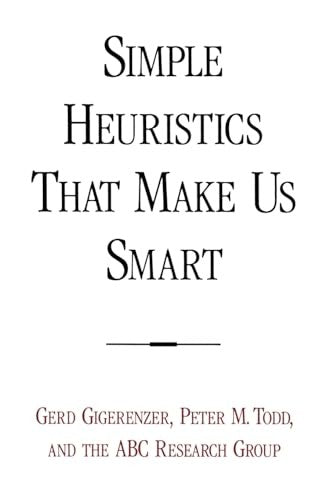
Simple Heuristics That Make Us Smart by Peter Todd
Simple Heuristics That Make Us Smart invites readers to embark on a new journey into a land of rationality that differs from the familiar territory of cognitive science and economics. Traditional views of rationality tend to see decision makers as possessing superhuman powers of reason, limitless knowledge, and all of eternity in which to ponder choices. To understand decisions in the real world, we need a different, more psychologically plausible notion of rationality, and this book provides it. It is about fast and frugal heuristics--simple rules for making decisions when time is pressing and deep thought an unaffordable luxury. These heuristics can enable both living organisms and artificial systems to make smart choices, classifications, and predictions by employing bounded rationality. But when and how can such fast and frugal heuristics work? Can judgments based simply on one good reason be as accurate as those based on many reasons? Could less knowledge even lead to systematically better predictions than more knowledge? Simple Heuristics explores these questions, developing computational models of heuristics and testing them through experiments and analyses. It shows how fast and frugal heuristics can produce adaptive decisions in situations as varied as choosing a mate, dividing resources among offspring, predicting high school drop out rates, and playing the stock market. As an interdisciplinary work that is both useful and engaging, this book will appeal to a wide audience. It is ideal for researchers in cognitive psychology, evolutionary psychology, and cognitive science, as well as in economics and artificial intelligence. It will also inspire anyone interested in simply making good decisions.
"How do people cope in the real, complex world of confusing and overwhelming information and rapidly approaching deadlines? This important book starts a new quest for answersHere, Gigerenzer, Todd, and their lively research group show that simple heuristics are powerful tools that do surprisingly well. The field of decision making will never be the same again."--Donald A. Norman, author of Things That Make Us Smart and The Invisible Computer
"Gigerenzer & Todd's volume represents a major advance in our understanding of human reasoning, with many genuinely new ideas on how people think and an impressive body of data to back them up. Simple Heuristics is indispensable for cognitive psychologists, economists, and anyone else interested in reason and rationality."--Steven Pinker, author of How the Mind Works and Words and Rules
"In the past few years, the theory of rational (sensible) human behavior has broken loose from the illusory and empirically unsupported notion that deciding rationally means maximizing expected utility. Research has learned to take seriously and study empirically how real human beings ... actually address the vast complexities of the world they inhabit. Simple Heuristics ... offers a fascinating introduction to this revolution in cognitive science, striking a great blow for sanity in the approach to human rationality."--Herbert A. Simon, Carnegie Mellon University, and Nobel Laureate in Economics
"This book is a major contribution to the theory of bounded rationality. It illustrates that the surprising efficiency of fast and simple procedures is due to their fit with the structure of the environment in which they are used. The emphasis on this ecological rationality is an advance in a promising and already fruitful new direction of research."--Reinhard Selten, Professor of Economics at the University of Bonn, and Nobel Laureate in Economics
"In recent years, and particularly in the culture wars, many people have written about rationality. These authors now provide a summary of this recent history, organized on the basis of different types of decision making. In each case, the authors summarize the literature so as to provide an implicit history. But the book is more fundamentally aimed at making rationality workable by showing 'the way that real people make the majority of their inferences and decisions.'"--Journal of the History of the Behavioral Sciences
"Gigerenzer & Todd's volume represents a major advance in our understanding of human reasoning, with many genuinely new ideas on how people think and an impressive body of data to back them up. Simple Heuristics is indispensable for cognitive psychologists, economists, and anyone else interested in reason and rationality."--Steven Pinker, author of How the Mind Works and Words and Rules
"In the past few years, the theory of rational (sensible) human behavior has broken loose from the illusory and empirically unsupported notion that deciding rationally means maximizing expected utility. Research has learned to take seriously and study empirically how real human beings ... actually address the vast complexities of the world they inhabit. Simple Heuristics ... offers a fascinating introduction to this revolution in cognitive science, striking a great blow for sanity in the approach to human rationality."--Herbert A. Simon, Carnegie Mellon University, and Nobel Laureate in Economics
"This book is a major contribution to the theory of bounded rationality. It illustrates that the surprising efficiency of fast and simple procedures is due to their fit with the structure of the environment in which they are used. The emphasis on this ecological rationality is an advance in a promising and already fruitful new direction of research."--Reinhard Selten, Professor of Economics at the University of Bonn, and Nobel Laureate in Economics
"In recent years, and particularly in the culture wars, many people have written about rationality. These authors now provide a summary of this recent history, organized on the basis of different types of decision making. In each case, the authors summarize the literature so as to provide an implicit history. But the book is more fundamentally aimed at making rationality workable by showing 'the way that real people make the majority of their inferences and decisions.'"--Journal of the History of the Behavioral Sciences
Gerd Gigerenzer ist Direktor am Max-Planck-Institut fur Bildungsforschung in Berlin; Zeno G. Swijtink ist Professor fur Philosophie an der Sonoma State University; Theodore M. Porter ist Professor fur Geschichte an der University of California, Los Angeles. Lorraine Daston ist Direktorin am Max-Planck-Institut fur Wissenschaftsgeschichte in Berlin; John Beatty ist Professor fur Geschichte der Wissenschaft und Technologie an der University of Minnesota. Lorenz Kruger war bis zu seinem Tod Professor fur Philosophie an der Universitat Gottingen.
| SKU | Unavailable |
| ISBN 13 | 9780195143812 |
| ISBN 10 | 0195143817 |
| Title | Simple Heuristics That Make Us Smart |
| Author | Peter Todd |
| Series | Evolution And Cognition |
| Condition | Unavailable |
| Binding Type | Paperback |
| Publisher | Oxford University Press Inc |
| Year published | 2000-10-26 |
| Number of pages | 432 |
| Cover note | Book picture is for illustrative purposes only, actual binding, cover or edition may vary. |
| Note | Unavailable |