
Singing to the Lyre in Renaissance Italy


Singing to the Lyre in Renaissance Italy
Regular price
Checking stock...
Regular price
Checking stock...
Summary
Vernacular poetry in Renaissance Italy was typically created and disseminated by improvising singer-poets. This is the first comprehensive study of cantare ad lyram (singing to the lyre), the dominant form of solo singing in Italy prior to the mid-sixteenth century, and of the related oral practices of memory and improvisation.
The feel-good place to buy books
- Free delivery in Ireland
- Supporting authors with AuthorSHARE
- 100% recyclable packaging
- Proud to be a B Corp – A Business for good
- Buy-back with Ziffit
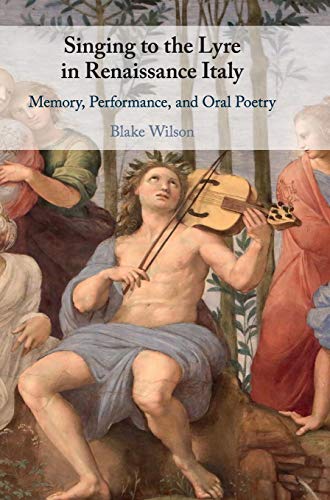
Singing to the Lyre in Renaissance Italy by Blake Wilson
A primary mode for the creation and dissemination of poetry in Renaissance Italy was the oral practice of singing and improvising verse to the accompaniment of a stringed instrument. Singing to the Lyre is the first comprehensive study of this ubiquitous practice, which was cultivated by performers ranging from popes, princes, and many artists, to professionals of both mercantile and humanist background. Common to all was a strong degree of mixed orality based on a synergy between writing and the oral operations of memory, improvisation, and performance. As a cultural practice deeply rooted in language and supported by ancient precedent, cantare ad lyram (singing to the lyre) is also a reflection of Renaissance cultural priorities, including the status of vernacular poetry, the study and practice of rhetoric, the oral foundations of humanist education, and the performative culture of the courts reflected in theatrical presentations and Castiglione's Il cortegiano.
'For many years Blake Wilson has tantalised us with a string of articles on singers of improvised verse in Italy in the Middle Ages and early RenaissanceNow, with this important and wide-ranging book, we come to know the world of the cantarini, from simple street singers to accomplished improvisers of versified epics performing in public, to refined singers 'to the lyre', without whom no festivity or banquet was complete. Drawing on a wide range of materials, Wilson is able to trace the lives of the famous canterini in surprising detail. Along the way, we learn of the longevity of the chanson de geste; the attraction of blind singers to the profession; the role of memory in improvisation; the art of performing extempore verse; the question of improvised verse as intellectual property; and above all, the central figure of Orpheus, in philosophy, religion, poetry, theatre, and music.' Bonnie J. Blackburn, Wolfson College, Oxford
Blake Wilson is Professor Emeritus of Music at Dickinson College, Pennsylvania. He is the recipient of grants and fellowships from the National Endowment for the Humanities (NEH), American Council of Learned Societies (ACLS), Fulbright Program, Harvard Center for Italian Renaissance Studies (Villa I Tatti), and the National Humanities Center. His research interests include the vernacular song cultures of Medieval and Renaissance Italy, Medici music patronage, the musical soundscapes of Italian cities, orality and literacy, and the intersections between aural, visual, and literary cultures. His works have appeared in books, editions, and journals, including the New Grove Dictionary of Music and Musicians, the Journal of Musicology, Early Music History, Recercare, Rivista Italiana di Musicologia, and I Tatti Studies.
| SKU | Unavailable |
| ISBN 13 | 9781108488075 |
| ISBN 10 | 1108488072 |
| Title | Singing to the Lyre in Renaissance Italy |
| Author | Blake Wilson |
| Condition | Unavailable |
| Binding Type | Hardback |
| Publisher | Cambridge University Press |
| Year published | 2019-11-21 |
| Number of pages | 484 |
| Cover note | Book picture is for illustrative purposes only, actual binding, cover or edition may vary. |
| Note | Unavailable |