
Style Guide


Style Guide
Regular price
Checking stock...
Regular price
Checking stock...
Proud to be B-Corp
Our business meets the highest standards of verified social and environmental performance, public transparency and legal accountability to balance profit and purpose. In short, we care about people and the planet.
The feel-good place to buy books
- Free delivery in Ireland
- Supporting authors with AuthorSHARE
- 100% recyclable packaging
- Proud to be a B Corp – A Business for good
- Buy-back with Ziffit
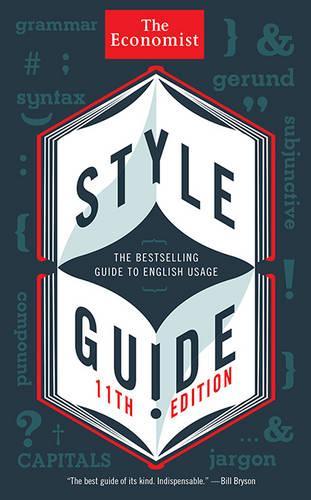
Style Guide by The Economist
This expanded eleventh edition of the bestselling guide to style is based on the Economist's own updated house style manual, and is an invaluable companion for everyone who wants to communicate with the clarity, style and precision for which the Economist is renowned. As the introduction says, 'clarity of writing usually follows clarity of thought.' The Economist Style Guide gives general advice on writing, points out common errors and clich's, offers guidance on consistent use of punctuation, abbreviations and capital letters, and contains an exhaustive range of reference material - covering everything from accountancy ratios and stock market indices to laws of nature and science. Some of the numerous useful rules and common mistakes pointed out in the guide include:*Which informs, that defines. This is the house that Jack built. But: This house, which Jack built, is now falling down.
Discreet means circumspect or prudent; discrete means separate or distinct. Remember that Questions are never indiscreet. Answers sometimes are (Oscar Wilde).
Flaunt means display, flout means disdain. If you flout this distinction you will flaunt your ignorance
Forgo means do without; forego means go before.
Fortuitous means accidental, not fortunate or well-timed.
Times: Take care. Three times more than X is four times as much as X.
Full stops: Use plenty. They keep sentences short. This helps the reader.
Bill Emmott was the editor-in-chief of the Economist from 1993 to 2006, and is now a writer and consultant on international affairs. He is a regular contributor to the Financial Times in London, La Stampa in Italy, Nikkei Business in Japan, and for Project Syndicate worldwide. He is a trustee of the International Institute for Strategic Studies, a Visiting Professor at Shujitsu University, and global economic adviser for Stonehenge Fleming Family & Partners. He is the author of several books, including 20:21 Vision, Rivals, and Good Italy, Bad Italy. He is also the narrator and co-author, with Annalisa Piras, of a documentary about Italy, Girlfriend in a Coma. In 2015, he produced The Great European Disaster Movie, which has now been seen by 2,500,000 people in twelve countries and translated into ten languages.
| SKU | Unavailable |
| ISBN 13 | 9781610395380 |
| ISBN 10 | 1610395387 |
| Title | Style Guide |
| Author | The Economist |
| Series | Economist Books |
| Condition | Unavailable |
| Binding Type | Paperback |
| Publisher | Economist |
| Year published | 2015-06-23 |
| Number of pages | 288 |
| Cover note | Book picture is for illustrative purposes only, actual binding, cover or edition may vary. |
| Note | Unavailable |