
Telescopes: A Very Short Introduction


Telescopes: A Very Short Introduction
Regular price
Checking stock...
Regular price
Checking stock...
Summary
Geoffrey Cottrell describes the rise of telescopes from early optical examples to the sophisticated range of modern telescopes on Earth and in space, opening up the cosmos in views from radio waves to gamma rays. Looking forward, he discusses the possibilities of the new generation of telescopes in construction today.
The feel-good place to buy books
- Free delivery in Ireland
- Supporting authors with AuthorSHARE
- 100% recyclable packaging
- Proud to be a B Corp – A Business for good
- Buy-back with Ziffit
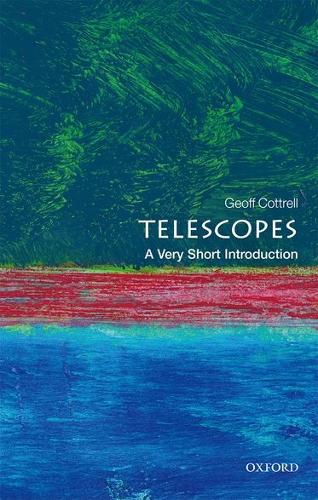
Telescopes: A Very Short Introduction by Geoff Cottrell
From the first, telescopes have made dramatic revelations about the Universe and our place in it. Galileo's observations of the Moon's cratered surface and discovery of Jupiter's four big satellites profoundly altered the perception of the heavens, overturning a two-thousand year cosmology that held the Earth to be the centre of the Universe. Over the past century, the rapid development of computer technology and sophisticated materials allowed enormous strides in the construction of telescopes. Modern telescopes range from large Earth-based optical telescopes and radio arrays linking up across continents, to space-based telescopes capturing the Universe in infrared, ultraviolet, X-rays, and gamma rays. In combination, they have enabled us to look deep into the Universe and far back in time, capturing phenomena from galactic collisions to the formation of stars and planetary systems, and mapping the faint glow remaining from the Big Bang. In this Very Short Introduction, Dr. Geoff Cottrell describes the basic physics of telescopes, the challenges of overcoming turbulence and distortion from the Earth's atmosphere, and the special techniques used to capture X-rays and gamma rays in space telescopes. He explains the crucial developments in detectors and spectrographs that have enabled the high resolution achieved by modern telescopes, and the hopes for the new generation of telescopes currently being built across the world. ABOUT THE SERIES: The Very Short Introductions series from Oxford University Press contains hundreds of titles in almost every subject area. These pocket-sized books are the perfect way to get ahead in a new subject quickly. Our expert authors combine facts, analysis, perspective, new ideas, and enthusiasm to make interesting and challenging topics highly readable.
The prose is authoritative and insightful * Ben Evans, BBC Sky At Night *
Dr. Geoff Cottrell began his career as a radio astronomer at Cambridge, observing colliding galaxies. He then moved to plasma physics, to Culham Centre For Fusion Energy and the Joint European Torus (JET) project, working on magnetically confined plasmas, hotter than the centre of the Sun, where he identified a new form of super-thermal radio emission from fusion alpha-particles. He was Director of the Culham International Summer School for Plasma Physics from 2006-2011. He has now returned to his first love, astrophysics, and in recent years has worked with Chris Lintott at Oxford University on the citizen science project, Galaxy Zoo. He is a Fellow of the Royal Astronomical Society, and visiting scientist at Rutherford Appleton laboratories, and at the Oxford University Astrophysics Department.
| SKU | Unavailable |
| ISBN 13 | 9780198745860 |
| ISBN 10 | 0198745869 |
| Title | Telescopes: A Very Short Introduction |
| Author | Geoff Cottrell |
| Series | Very Short Introductions |
| Condition | Unavailable |
| Binding Type | Paperback |
| Publisher | Oxford University Press |
| Year published | 2016-12-08 |
| Number of pages | 176 |
| Cover note | Book picture is for illustrative purposes only, actual binding, cover or edition may vary. |
| Note | Unavailable |