
Alan Turing's Systems of Logic


Alan Turing's Systems of Logic
Regular price
Checking stock...
Regular price
Checking stock...
Résumé
Between inventing the concept of a universal computer in 1936 and breaking the German Enigma code during World War II, Alan Turing (1912-1954), the British founder of computer science and artificial intelligence, came to Princeton University to study mathematical logic. Some of the greatest logicians in the world--including Alonzo Church, Kurt Gode
The feel-good place to buy books
- Free delivery in the UK
- Supporting authors with AuthorSHARE
- 100% recyclable packaging
- B Corp - kinder to people and planet
- Buy-back with World of Books - Sell Your Books
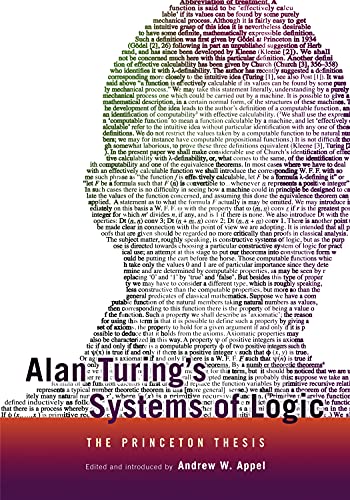
Alan Turing's Systems of Logic by Andrew W Appel
Between inventing the concept of a universal computer in 1936 and breaking the German Enigma code during World War II, Alan Turing (1912-1954), the British founder of computer science and artificial intelligence, came to Princeton University to study mathematical logic. Some of the greatest logicians in the world--including Alonzo Church, Kurt Godel, John von Neumann, and Stephen Kleene--were at Princeton in the 1930s, and they were working on ideas that would lay the groundwork for what would become known as computer science. This book presents a facsimile of the original typescript of Turing's fascinating and influential 1938 Princeton PhD thesis, one of the key documents in the history of mathematics and computer science. The book also features essays by Andrew Appel and Solomon Feferman that explain the still-unfolding significance of the ideas Turing developed at Princeton. A work of philosophy as well as mathematics, Turing's thesis envisions a practical goal--a logical system to formalize mathematical proofs so they can be checked mechanically. If every step of a theorem could be verified mechanically, the burden on intuition would be limited to the axioms. Turing's point, as Appel writes, is that "mathematical reasoning can be done, and should be done, in mechanizable formal logic." Turing's vision of "constructive systems of logic for practical use" has become reality: in the twenty-first century, automated "formal methods" are now routine. Presented here in its original form, this fascinating thesis is one of the key documents in the history of mathematics and computer science.
"This book presents the story of Turing's work at Princeton University and includes a facsimile of his doctoral dissertation, 'Systems of Logic Based on Ordinals,' which he completed in 1936The author includes a detailed history of Turing's work in computer science and the attempts to ground the field in formal logic."--Mathematics Teacher "This book is not for the faint hearted, as with the great masters of painting it will insist that some thought goes into appreciating it... I love the book as a book. It is a collectors item and after all what better pursuit can one have than collecting books!"--Patrick Fogarty, Mathematics Today
Andrew W. Appel is the Eugene Higgins Professor and Chairman of the Department of Computer Science at Princeton University.
| SKU | Non disponible |
| ISBN 13 | 9780691164731 |
| ISBN 10 | 0691164738 |
| Titre | Alan Turing's Systems of Logic |
| Auteur | Andrew W Appel |
| État | Non disponible |
| Type de reliure | Paperback |
| Éditeur | Princeton University Press |
| Année de publication | 2014-11-16 |
| Nombre de pages | 160 |
| Note de couverture | La photo du livre est présentée à titre d'illustration uniquement. La reliure, la couverture ou l'édition réelle peuvent varier. |
| Note | Non disponible |