
Coping Effectively With Spinal Cord Injuries A Group Program Therapist Guide


Coping Effectively With Spinal Cord Injuries A Group Program Therapist Guide
Regular price
Checking stock...
Regular price
Checking stock...
Proud to be B-Corp
Our business meets the highest standards of verified social and environmental performance, public transparency and legal accountability to balance profit and purpose. In short, we care about people and the planet.
The feel-good place to buy books
- Free delivery in the UK
- Supporting authors with AuthorSHARE
- 100% recyclable packaging
- B Corp - kinder to people and planet
- Buy-back with World of Books - Sell Your Books
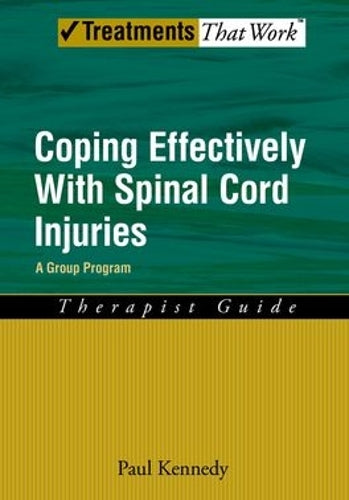
Coping Effectively With Spinal Cord Injuries A Group Program Therapist Guide by Paul Kennedy
For individuals who have suffered a spinal cord injury, it is a struggle to know how to assess and cope with such a life-changing event. The coping strategies that a person employs can have an enormous impact on their mental well-being and long-term health. Approach focused coping, in which the individual accepts and seeks to understand their condition, results in a sense of mastery, self-efficacy, and post traumatic growth. Conversely, avoidance focused coping can lead to anxiety, depression, self neglect, and substance abuse problems. Approximately 50% will meet the diagnostic criteria for depression at 6 months post injury. Research shows that those with depression will have a poorer outcome and shorter life-span. Coping effectiveness training (CET) aims to improve skills for assessing stress, teaching a range of coping skills that can be used to tackle stress, and provide an opportunity for interaction with others who have similar experiences of spinal cord injury. CET includes the identification of effective and ineffective responses to stress, especially those that are particularly unhelpful, such as disengagement, general avoidance, long term denial, and the expression of extreme emotion. By encouraging individuals to think critically about their behaviour in response to stressors, CET helps people avoid unproductive ways of coping. Like all TreatmentsThatWork programs, this treatment is evidence-based. In the author's clinical studies, CET has proven to successfully reduce levels of depression and anxiety in individuals with spinal cord injury, and also resulted in changes in negative self-perception and improved self-efficiacy. The intervention consists of seven, 60-75 minute sessions run two a week in small groups of six to nine people. By working in small groups, participants are able to share experience and build a community, reducing the sense of isolation that often results from sever injury. A corresponding workbook provides monitoring forms, homework exercises, and other user-friendly techniques to continue the work outside of therapy.Paul Kennedy is Professor of Clinical Psychology at the University of Oxford and Academic Director of the Oxford Doctoral Course in Clinical Psychology at the University of Oxford, UK.
| SKU | Non disponible |
| ISBN 13 | 9780195339727 |
| ISBN 10 | 019533972X |
| Titre | Coping Effectively With Spinal Cord Injuries A Group Program Therapist Guide |
| Auteur | Paul Kennedy |
| Série | Treatments That Work |
| État | Non disponible |
| Type de reliure | Paperback |
| Éditeur | Oxford University Press Inc |
| Année de publication | 2008-11-27 |
| Nombre de pages | 80 |
| Note de couverture | La photo du livre est présentée à titre d'illustration uniquement. La reliure, la couverture ou l'édition réelle peuvent varier. |
| Note | Non disponible |