
Design of Steel-Concrete Composite Structures Using High-Strength Materials


Design of Steel-Concrete Composite Structures Using High-Strength Materials
Regular price
Checking stock...
Regular price
Checking stock...
Proud to be B-Corp
Our business meets the highest standards of verified social and environmental performance, public transparency and legal accountability to balance profit and purpose. In short, we care about people and the planet.
The feel-good place to buy books
- Free delivery in the UK
- Supporting authors with AuthorSHARE
- 100% recyclable packaging
- B Corp - kinder to people and planet
- Buy-back with World of Books - Sell Your Books
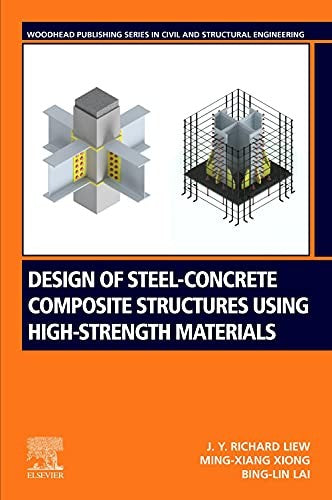
Design of Steel-Concrete Composite Structures Using High-Strength Materials by Jy Richard Liew
High-strength materials offer alternatives to frequently used materials for high-rise construction. A material of higher strength means a smaller member size is required to resist the design load. However, high-strength concrete is brittle, and high-strength thin steel plates are prone to local buckling. A solution to overcome such problems is to adopt a steel-concrete composite design in which concrete provides lateral restraint to steel plates against local buckling, and steel plates provide confinement to high-strength concrete. Design of Steel-Concrete Composite Structures Using High Strength Materials provides guidance on the design of composite steel-concrete structures using combined high-strength concretes and steels. The book includes a database of over 2,500 test results on composite columns to evaluate design methods, and presents calculations to determine critical parameters affecting the strength and ductility of high-strength composite columns. Finally, the book proposes design methods for axial-moment interaction curves in composite columns. This allows a unified approach to the design of columns with normal- and high-strength steel concrete materials. This book offers civil engineers, structural engineers, and researchers studying the mechanical performance of composite structures in the use of high-strength materials to design and construct advanced tall buildings.
J. Y. Richard Liew is a professor in the Department of Civil and Environmental Engineering at the National University of Singapore, Singapore. He is also a chartered engineer in the UK, a professional engineer in Singapore, and a chartered professional engineer of the Association of Southeast Asian Nations. He has co-authored 5 books, more than 400 technical publications, sits on the boards of international journals, holds several honorary positions, and is a key person responsible for the development of Singapore’s national annexes for the design and steel and composite structures using Eurocodes 3 and 4. Ming-Xiang Xiong is an associate professor in the School of Civil Engineering, Guangzhou University, Guangdong, China. He received his doctorate from the National University of Singapore. He has been involved in composite structure research and design for more than 15 years, and his extensive research focuses on steel-concrete composite structures subjected to static and extreme environmental load. He has authored and co-authored more than 20 journal papers and the Singapore code on composite structures known as BC4:2015. Bing-Lin Lai is an assistant professor in the School of Civil Engineering, Southeast University, Nanjing, China. He received his doctorate from the National University of Singapore. His research mainly focuses on the behaviour and design of high-performance steel-concrete composite structures and prefabricated prefinished volumetric construction. He has authored and co-authored over 10 journal papers.
| SKU | Non disponible |
| ISBN 13 | 9780128233962 |
| ISBN 10 | 0128233966 |
| Titre | Design of Steel-Concrete Composite Structures Using High-Strength Materials |
| Auteur | Jy Richard Liew |
| Série | Woodhead Publishing Series In Civil And Structural Engineering |
| État | Non disponible |
| Type de reliure | Paperback |
| Éditeur | Elsevier Science Publishing Co Inc |
| Année de publication | 2021-08-12 |
| Nombre de pages | 254 |
| Note de couverture | La photo du livre est présentée à titre d'illustration uniquement. La reliure, la couverture ou l'édition réelle peuvent varier. |
| Note | Non disponible |