
The Essential Writings of Jonathan Swift


The Essential Writings of Jonathan Swift
Regular price
Checking stock...
Regular price
Checking stock...
Résumé
Presents a range of Swift's writing, including not only the major literary prose works but also substantial poetic and political writings. This title includes a selection of contemporary materials, along with criticism, a chronology and bibliography.
The feel-good place to buy books
- Free delivery in the UK
- Supporting authors with AuthorSHARE
- 100% recyclable packaging
- B Corp - kinder to people and planet
- Buy-back with World of Books - Sell Your Books
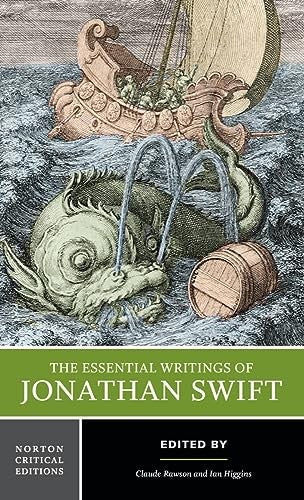
The Essential Writings of Jonathan Swift by Jonathan Swift
“Contexts” features a generous selection of contemporary materials, among them Swift's letters, autobiographical documents, and personal writings. “Criticism” provides readers with a wide chronological and thematic range of scholarly interpretations, divided into two sections. The first, “1745–1940,” includes assessments by Henry Fielding, Samuel Johnson, Samuel Taylor Coleridge, William Makepeace Thackeray, D. H. Lawrence, W. B. Yeats, F. R. Leavis, and André Breton, among others. The second, “After 1940,” is by subject and collects critical discussions of A Tale of the Tub, the poems, the English and Irish politics, and Gulliver’s Travels, by Hugh Kenner, Marcus Walsh, Irvin Ehrenpreis, Penelope Wilson, Derek Mahon, S. J. Connolly, George Orwell, R. S. Crane, Jenny Mezciems, Ian Higgins, and Claude Rawson. A Chronology and Selected Bibliography are also included.
Jonathan Swift was born in Dublin, to English parents, in 1667. Educated at Trinity College, Dublin, and Oxford, he was ordained in the Anglican Church in 1795 and later served for more than three decades as Dean of St. Patrick’s Cathedral in Dublin. In 1704, he published the religious-themed A Tale of a Tub, the first of the trenchantly satirical works on which his reputation rests. Along with his friends Alexander Pope and John Gay, Swift helped make the eighteenth century a golden age of social and political satire in Britain. After a brief stint as a Tory pamphleteer in London, the self-styled Irish patriot returned to Dublin in 1714. In later years, he vented what he called his “savage indignation” in a wide range of literary registers, from the Rabelaisian humor of his masterpiece, Gulliver’s Travels (1726), to the dystopian vision of infanticide in A Modest Proposal (1729). He died in 1745. Claude Rawson is Maynard Mack Professor of English at Yale University. He is the author of God, Gulliver, and Genocide: Barbarism and the European Imagination: 1492–1945, English Satire and the Satire Tradition, and Satire and Sentiment, 1660–1830: Stress Points in the English Augustan Tradition. He is General Editor of the Works of Jonathan Swift (Cambridge University Press) and co-editor, with Ian Higgins, of the Oxford World Classics edition of Gulliver's Travels. Ian Higgins is the author of Swift's Politics: A Study in Disaffection (1994) and Jonathan Swift (2004), and is an editor (with Claude Rawson) of Gulliver's Travels (2005). He is a Reader in English at the Australian National University in Canberra, Australia, where he teaches courses on early modern and eighteenth-century literature and on British imperial fiction.
| SKU | Non disponible |
| ISBN 13 | 9780393930658 |
| ISBN 10 | 0393930653 |
| Titre | The Essential Writings of Jonathan Swift |
| Auteur | Jonathan Swift |
| Série | Norton Critical Editions |
| État | Non disponible |
| Type de reliure | Paperback |
| Éditeur | WW Norton & Co |
| Année de publication | 2009-10-23 |
| Nombre de pages | 944 |
| Note de couverture | La photo du livre est présentée à titre d'illustration uniquement. La reliure, la couverture ou l'édition réelle peuvent varier. |
| Note | Non disponible |