
How to do your Case Study


How to do your Case Study
Résumé
In this lucid, accessible and often witty text, Gary Thomas introduces students and researchers to the basics of case study research.
The feel-good place to buy books
- Free delivery in the UK
- Supporting authors with AuthorSHARE
- 100% recyclable packaging
- B Corp - kinder to people and planet
- Buy-back with World of Books - Sell Your Books
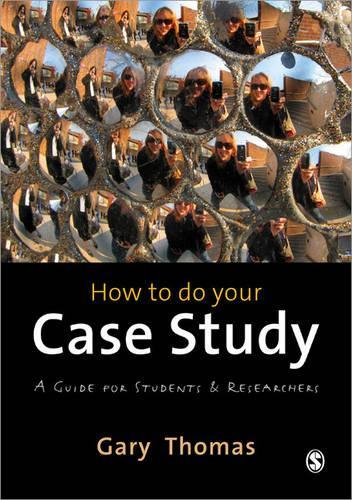
How to do your Case Study by Gary Thomas
Case Study is one of the most widely applied methods of research and instruction in use today. Cases are used to frame research, aid teaching and help learning the world over. Yet, despite being so widely used, there remains a great deal of uncertainty about what constitutes case study research and how case studies should be designed and carried out. In this lucid, accessible and often witty new text, Gary Thomas introduces students and researchers to the basics of case study research. Using a wide range of real-life examples, this book sets out for those new to the method how best to design and carry out case studies in the social sciences and humanities How to do your case study: a guide for students and researchers deals with the core issues and methods that anyone new to case study will need to understand: - What is a case study? - When and why should case study methods be used? - How are case studies designed? - What methods can be used? - How do we analyse and make sense of our data? - How do we write up and write about our case? How to do your Case Study will be essential reading for any student or researcher in the Social Sciences, Health Sciences, in Business Studies, in Education and the Humanities.John Elliot
Emeritus Professor of Education, University of East Anglia
All chapters are clearly structured but with an eye for presenting variations of research designs, purposes, approaches, data collections and tools for analysis across applied social sciences and humanities. The chapters are written in a lively, engaged and personal manner - though highly academic and structured in their argumentation at the same time - and as a nice student-friendly communicative feature, each chapter finishes with a short section called "If you only take one thing from this chapter, take this..."... I can recommend Thomas′ book as an inspiring and systematic companion to think and discuss with, where there is tolerance towards the wonderful variability of doing qualitative research.
Bente Halkier
Roskilde University
This particular text will replace a few "classics" on my shelf, and I plan to use the book when teaching my methodology courses. -- P. Taylor Webb * Educational Review *
| SKU | Non disponible |
| ISBN 13 | 9780857025630 |
| ISBN 10 | 0857025635 |
| Titre | How to do your Case Study |
| Auteur | Gary Thomas |
| État | Non disponible |
| Type de reliure | Paperback |
| Éditeur | Sage Publications Ltd |
| Année de publication | 2010-12-14 |
| Nombre de pages | 248 |
| Note de couverture | La photo du livre est présentée à titre d'illustration uniquement. La reliure, la couverture ou l'édition réelle peuvent varier. |
| Note | Non disponible |