
An Introduction to Error Analysis


An Introduction to Error Analysis
Proud to be B-Corp
Our business meets the highest standards of verified social and environmental performance, public transparency and legal accountability to balance profit and purpose. In short, we care about people and the planet.
The feel-good place to buy books
- Free delivery in the UK
- Supporting authors with AuthorSHARE
- 100% recyclable packaging
- B Corp - kinder to people and planet
- Buy-back with World of Books - Sell Your Books
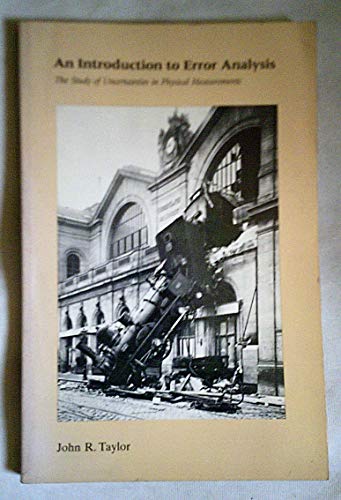
An Introduction to Error Analysis by John R Taylor
This remarkable text by John R. Taylor has been a non-stop best-selling international hit since it was first published forty years ago. However, the two-plus decades since the second edition was released have seen two dramatic developments; the huge rise in popularity of Bayesian statistics, and the continued increase in the power and availability of computers and calculators. In response to the former, Taylor has added a full chapter dedicated to Bayesian thinking, introducing conditional probabilities and Bayes' theorem. The several examples presented in the new third edition are intentionally very simple, designed to give readers a clear understanding of what Bayesian statistics is all about as their first step on a journey to become practicing Bayesians. In response to the second development, Taylor has added a number of chapter-ending problems that will encourage readers to learn how to solve problems using computers. While many of these can be solved using programs such as Matlab or Mathematica, almost all of them are stated to apply to commonly available spreadsheet programs like Microsoft Excel. These programs provide a convenient way to record and process data and to calculate quantities like standard deviations, correlation coefficients, and normal distributions; they also have the wonderful ability - if students construct their own spreadsheets and avoid the temptation to use built-in functions - to teach the meaning of these concepts.This remarkable text by John R. Taylor has been a non-stop best-selling international hit since it was first published forty years ago. However, the two-plus decades since the second edition was released have seen two dramatic developments; the huge rise in popularity of Bayesian statistics, and the continued increase in the power and availability of computers and calculators. In response to the former, Taylor has added a full chapter dedicated to Bayesian thinking, introducing conditional probabilities and Bayes' theorem. The several examples presented in the new third edition are intentionally very simple, designed to give readers a clear understanding of what Bayesian statistics is all about as their first step on a journey to become practicing Bayesians. In response to the second development, Taylor has added a number of chapter-ending problems that will encourage readers to learn how to solve problems using computers. While many of these can be solved using programs such as Matlab or Mathematica, almost all of them are stated to apply to commonly available spreadsheet programs like Microsoft Excel. These programs provide a convenient way to record and process data and to calculate quantities like standard deviations, correlation coefficients, and normal distributions; they also have the wonderful ability - if students construct their own spreadsheets and avoid the temptation to use built-in functions - to teach the meaning of these concepts.
| SKU | Non disponible |
| ISBN 13 | 9780935702101 |
| ISBN 10 | 0935702105 |
| Titre | An Introduction to Error Analysis |
| Auteur | John R Taylor |
| État | Non disponible |
| Type de reliure | Paperback |
| Éditeur | University Science Books,U.S. |
| Année de publication | 1982-01-01 |
| Nombre de pages | 270 |
| Note de couverture | La photo du livre est présentée à titre d'illustration uniquement. La reliure, la couverture ou l'édition réelle peuvent varier. |
| Note | Non disponible |