
Maggie: A Girl of the Streets


Maggie: A Girl of the Streets
Résumé
First published in 1893, when Stephen Crane was only twenty-one years old, Maggie is the harrowing tale of a young woman's fall into prostitution and destitution in New York City's notorious Bowery slum. The appendices provide an unrivalled range of documentary sources.
The feel-good place to buy books
- Free delivery in the UK
- Supporting authors with AuthorSHARE
- 100% recyclable packaging
- B Corp - kinder to people and planet
- Buy-back with World of Books - Sell Your Books
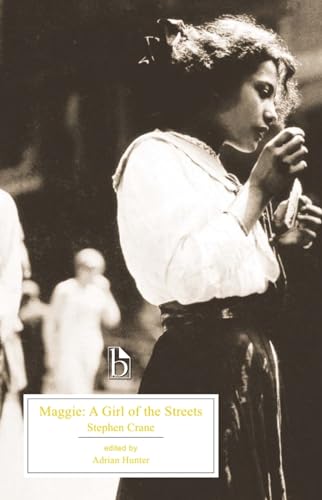
Maggie: A Girl of the Streets by Stephen Crane
MAGIE: A GIRL OF THE STRETS is an 1893 novella by American author Stephen Crane (1871-1900). The story centers on Maggie, a young girl from the Bowery who is driven to unfortunate circumstances by poverty and solitude. The work was considered risqu by publishers because of its literary realism and strong themes. Crane - who was 22 years old at the time - financed the book's publication himself, although the original 1893 edition was printed under the pseudonym Johnston Smith. After the success of 1895's The Red Badge of Courage, Maggie was reissued in 1896 with considerable changes and re-writing. The story is followed by George's Mother. MAGIE was published during the time of industrialization. The United States, a country shaped by agriculture in the 19th century, became an industrialized nation in the late 1800s. Moreover, an unprecedented influx of immigrants contributed to a boom in population, created bigger cities and a new consumer society. By these developments, progress was linked with poverty, illustrating that the majority of the US population was skeptical about the dependency on the fluctuation of global economy. MAGIE is regarded as the first work of unalloyed naturalism in American fiction.-Milne Holton. According to the naturalistic principles, a character is set into a world where there is no escape from one's biological heredity. Additionally, the circumstances in which a person finds oneself will dominate one's behavior, depriving the individual of responsibility. Although Stephen Crane denied any influence by mile Zola, the creator of Naturalism, on his work, examples in his texts indicate that this American author was inspired by French naturalism.MAGIE: A GIRL OF THE STRETS is an 1893 novella by American author Stephen Crane (1871-1900). The story centers on Maggie, a young girl from the Bowery who is driven to unfortunate circumstances by poverty and solitude. The work was considered risqu by publishers because of its literary realism and strong themes. Crane - who was 22 years old at the time - financed the book's publication himself, although the original 1893 edition was printed under the pseudonym Johnston Smith. After the success of 1895's The Red Badge of Courage, Maggie was reissued in 1896 with considerable changes and re-writing. The story is followed by George's Mother. MAGIE was published during the time of industrialization. The United States, a country shaped by agriculture in the 19th century, became an industrialized nation in the late 1800s. Moreover, an unprecedented influx of immigrants contributed to a boom in population, created bigger cities and a new consumer society. By these developments, progress was linked with poverty, illustrating that the majority of the US population was skeptical about the dependency on the fluctuation of global economy. MAGIE is regarded as the first work of unalloyed naturalism in American fiction.-Milne Holton. According to the naturalistic principles, a character is set into a world where there is no escape from one's biological heredity. Additionally, the circumstances in which a person finds oneself will dominate one's behavior, depriving the individual of responsibility. Although Stephen Crane denied any influence by mile Zola, the creator of Naturalism, on his work, examples in his texts indicate that this American author was inspired by French naturalism.
“Adrian Hunter’s elegant introduction and judicious selection of essential contextual documents by Crane and his contemporaries make this edition of Maggie wonderfully useful for students, teachers, and interested readers” — Michael Robertson, The College of New Jersey, author of Stephen Crane, Journalism, and the Making of Modern American Literature
“Adrian Hunter’s introduction is elegantly written and solidly researched. Many less perceptive critics have tended to apply broad labels to Crane and his work, but Hunter has provided a wonderfully nuanced and sophisticated analysis of this often neglected text and the complex social and historical context from which it emerges. The edition is intelligently organized and carefully annotated; I found the appendices on reform movements and on slum fiction particularly useful.” — Susan Castillo, King’s College, London
Crane's travels and experiences during the later 1890s as a war correspondent -- he was sent to the combat areas of Mex-ico, Greece, and Cuba -- furnished rich material for other sto-ries, including The Open Boat (based partly on Crane's own experience of shipwreck off the coast of Florida) and The Bride Comes to Yellow Sky, whose blend of realism and romanticism earned the praise of William Dean Howells, Theodore Dreiser, and other American realists. Crane also published two volumes of poetry, The Black Rider and Other Lines (1895) and War Is Kind (1899), which dramatized his rebellion against New England Calvinism and conservative evangelical Christianity. Spumed or ignored by the critics of his own country, Crane traveled with his wife-to--be to England, where The Red Badge of Courage was greatly admired, and where he made the acquaintance of such literary giants as Henry James (another American emigre) and Joseph Conrad. Crane's adventuresome and roving lifestyle seriously under-mined his health; after fruitless efforts to obtain a cure, he died of tuberculosis in Badenweiler, Germany, on June 5, 1900, at the age of twenty-eight. Stephen Crane published other novels and several vol-umes of short stories, including George's Mother (1896), The Third Violet (1897), The Monster and Other Stories (1899), and Whilomville Stories (1900).
| SKU | Non disponible |
| ISBN 13 | 9781551115979 |
| ISBN 10 | 1551115972 |
| Titre | Maggie: A Girl of the Streets |
| Auteur | Stephen Crane |
| État | Non disponible |
| Type de reliure | Paperback |
| Éditeur | Broadview Press Ltd |
| Année de publication | 2006-09-30 |
| Nombre de pages | 200 |
| Note de couverture | La photo du livre est présentée à titre d'illustration uniquement. La reliure, la couverture ou l'édition réelle peuvent varier. |
| Note | Non disponible |