
Modular Forms and Fermat's Last Theorem


Modular Forms and Fermat's Last Theorem
Résumé
The book focuses on two major topics: Andrew Wiles' recent proof of the Taniyama-Shimura-Weil conjecture for semistable elliptic curves; and the earlier works of Frey, Serre, Ribet showing that Wiles' Theorem would complete the proof of Fermat's Last Theorem.
The feel-good place to buy books
- Free delivery in the UK
- Supporting authors with AuthorSHARE
- 100% recyclable packaging
- B Corp - kinder to people and planet
- Buy-back with World of Books - Sell Your Books
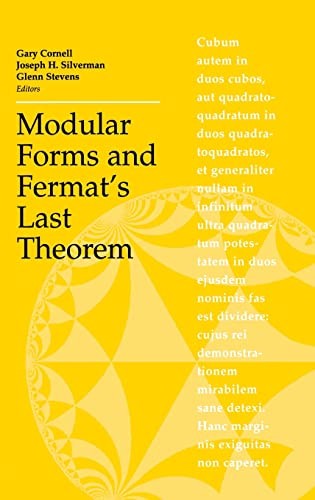
Modular Forms and Fermat's Last Theorem by Joseph Silverman
This volume contains expanded versions of lectures given at an instructional conference on number theory and arithmetic geometry held August 9 through 18, 1995 at Boston University. The purpose of the conference, and of this book, is to introduce and explain the many ideas and techniques used by Wiles in his proof that every (semi- stable) elliptic curve over Q is modular, and to explain how Wiles' result can be combined with Ribet's theorem and ideas of Frey and Serre to show, at long last, that Fermat's Last Theorem is true. Contributors to this volume include: B. Conrad, H. Darmon, E. de Shalit, B. de Smit, F. Diamond, S.J. Edixhoven, G. Frey, S. Gelbart, K. Kramer, H.W. Lenstra, Jr., B. Mazur, K. Ribet, D.E. Rohrlich, M. Rosen, K. Rubin, R. Schoof, A. Silverberg, J.H. Silverman, P. Stevenhagen, G. Stevens, J. Tate, J. Tilouine, and L. Washington. The book begins with an overview of the complete proof, followed by several introductory chapters surveying the basic theory of elliptic curves, modular functions, modular curves, Galois cohomology, and finite group schemes. Representation theory, which lies at the core of Wiles' proof, is dealt with in a chapter on automorphic representations and the Langlands-Tunnell theorem, and this is followed by in-depth discussions of Serre's conjectures, Galois deformations, universal deformation rings, Hecke algebras, complete intersections and more, as the reader is led step-by-step through Wiles' proof. In recognition of the historical significance of Fermat's Last Theorem, the volume concludes by looking both forward and backward in time, reflecting on the history of the problem, while placing Wiles' theorem into a more general Diophantine context suggesting future applications. Students and professional mathematicians alike will find this volume to be an indispensableDr. Joseph Silverman is a professor at Brown University and has been an instructor or professors since 1982. He was the Chair of the Brown Mathematics department from 2001-2004. He has received numerous fellowships, grants and awards, as well as being a frequently invited lecturer. He is currently a member of the Council of the American Mathematical Society. His research areas of interest are number theory, arithmetic geometry, elliptic curves, dynamical systems and cryptography. He has co-authored over 120 publications and has had over 20 doctoral students under his tutelage. He has published 9 highly successful books with Springer, including the recently released, An Introduction to Mathematical Cryptography, for Undergraduate Texts in Mathematics.
| SKU | Non disponible |
| ISBN 13 | 9780387946092 |
| ISBN 10 | 0387946098 |
| Titre | Modular Forms and Fermat's Last Theorem |
| Auteur | Joseph Silverman |
| État | Non disponible |
| Type de reliure | Hardback |
| Éditeur | Springer-Verlag New York Inc. |
| Année de publication | 2000-01-14 |
| Nombre de pages | 608 |
| Note de couverture | La photo du livre est présentée à titre d'illustration uniquement. La reliure, la couverture ou l'édition réelle peuvent varier. |
| Note | Non disponible |