
What's Wrong With The Rorschach


What's Wrong With The Rorschach
Regular price
Checking stock...
Regular price
Checking stock...
Résumé
Four academic psychologists question the validity and usefulness of the famous ink bolt test and the system of scoring, thereby challenging the utility of what is now a huge business of testing and judging people by their alleged reaction to ink blots in child custody disputes, educational placement, and employment opportunities.
The feel-good place to buy books
- Free delivery in the UK
- Supporting authors with AuthorSHARE
- 100% recyclable packaging
- B Corp - kinder to people and planet
- Buy-back with World of Books - Sell Your Books
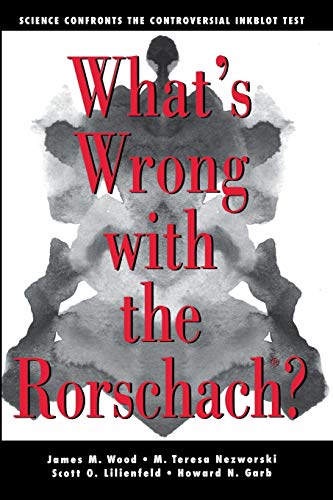
What's Wrong With The Rorschach by James M Wood
Since its creation more than eighty years ago, the famous Rorschach inkblot test has become an icon of clinical psychology and popular culture. Administered over one million times world-wide each year, the Rorschach is used to assess personality and mental illness across a wide range of circumstances: child custody disputes, educational placement decisions, employment and termination proceedings, parole determinations, and even investigations of child abuse allegations. The test's enormous power shapes the lives of hundreds of thousands of people -- often without their knowledge. In the 1970s, this notoriously subjective test was supposedly systematized and improved. But is the Rorschach more than a modern variant on tea leaf reading? What's Wrong With the Rorschach? challenges the validity and utility of the Rorschach and explains why psychologists continue to judge people by their reactions to ink blots, in spite of a half century of largely negative scientific evidence. What's Wrong With the Rorschach? offers a provocative critique of one of the most widely applied and influential - and still intensely controversial - psychological tests in the world today. Surveying more than fifty years of clinical and scholarly research, the authors provide compelling scientific evidence that the Rorschach has relatively little value for diagnosing mental illness, assessing personality, predicting behavior, or uncovering sexual abuse or other trauma. In this highly engaging, novelistic account of the Rorschach's origins and history, the authors detail the wealth of scientific evidence that the test is of questionable utility for real-world decision making. What's Wrong With the Rorschach? presents a powerfully reasoned case against using the test in the courtroom or consulting room - and reveals the strong psychological, economic, and political forces that continue to support the Rorschach despite the research that has exposed its shortcomings and dangers. James M. Wood (El Paso, TX) is Associate Professor, Department of Psychology, at the University of Texas at El Paso. M. Teresa Nezworski (Dallas, TX) is Associate Professor, Department of Psychology, University of Texas at Dallas. Scott O. Lilienfeld (Atlanta, GA) is an Associate Professor of Psychology at Emory University in Atlanta. Howard N. Garb (Pittsburgh, PA) is on the faculty at the University of Pittsburgh and the author of Studying the Clinician: Judgement Research and Psychological Assessment.
James M. Wood is an associate professor of psychology at the University of Texas at El Paso.
M. Teresa Nezworski is an associate professor in the Department of Psychology at the University of Texas at Dallas.
Scott O. Lilienfeld is an associate professor of psychology at Emory University in Atlanta.
Howard N. Garb is clinical associate professor of psychiatry in the School of Medicine at the University of Pittsburgh.
| SKU | Non disponible |
| ISBN 13 | 9781118087121 |
| ISBN 10 | 1118087127 |
| Titre | What's Wrong With The Rorschach |
| Auteur | James M Wood |
| État | Non disponible |
| Type de reliure | Paperback |
| Éditeur | John Wiley & Sons Inc |
| Année de publication | 2011-04-07 |
| Nombre de pages | 462 |
| Note de couverture | La photo du livre est présentée à titre d'illustration uniquement. La reliure, la couverture ou l'édition réelle peuvent varier. |
| Note | Non disponible |