


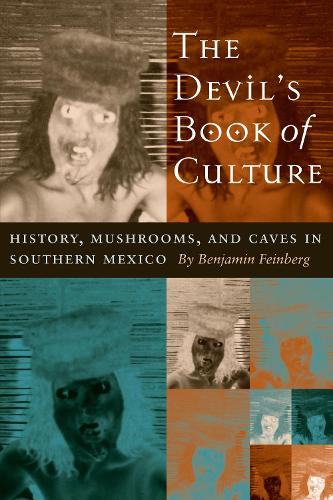
The Devil's Book of Culture by Benjamin Feinberg
Since the 1950s, the Sierra Mazateca of Oaxaca, Mexico, has drawn a strange assortment of visitors and pilgrims—schoolteachers and government workers, North American and European spelunkers exploring the region's vast cave system, and counterculturalists from hippies (John Lennon and other celebrities supposedly among them) to New Age seekers, all chasing a firsthand experience of transcendence and otherness through the ingestion of psychedelic mushrooms "in context" with a Mazatec shaman. Over time, this steady incursion of the outside world has significantly influenced the Mazatec sense of identity, giving rise to an ongoing discourse about what it means to be "us" and "them." In this highly original ethnography, Benjamin Feinberg investigates how different understandings of Mazatec identity and culture emerge through talk that circulates within and among various groups, including Mazatec-speaking businessmen, curers, peasants, intellectuals, anthropologists, bureaucrats, cavers, and mushroom-seeking tourists. Specifically, he traces how these groups express their sense of culture and identity through narratives about three nearby yet strange discursive "worlds"—the "magic world" of psychedelic mushrooms and shamanic practices, the underground world of caves and its associated folklore of supernatural beings and magical wealth, and the world of the past or the past/present relationship. Feinberg's research refutes the notion of a static Mazatec identity now changed by contact with the outside world, showing instead that identity forms at the intersection of multiple transnational discourses.
The author's elegant prose, at times raw, and peppered with colorful vignettes exposing the many foibles of fieldwork, makes for pleasurable and engaging readingPerhaps more importantly, Feinberg's work represents a significant theoretical contribution to the study of ethnic identity in Oaxaca, a topic of considerable anthropological narration. It demands a thorough reexamination of the very ways in which we study and write about indigenous "culture" by looking at how Mazatec identity is constructed through a host of intersecting metacultural discourses, including those of its ethnographers. While based on regionally specific ethnographic material, I highly recommend Feinberg's book not only to anthropologists, but also historians and others interested in critical theory and identity formation, as well as cultural and historical representation. * The Americas *
...Feinberg's insights are penetrating and he makes important contributions to theoretical critiques of the concept of culture. * The Journal of Latin American Anthropology *
...Feinberg's insights are penetrating and he makes important contributions to theoretical critiques of the concept of culture. * The Journal of Latin American Anthropology *
Benjamin Feinberg is Professor of Anthropology at Warren Wilson College in Asheville, North Carolina.
| SKU | Unavailable |
| ISBN 13 | 9780292701908 |
| ISBN 10 | 029270190X |
| Title | The Devil's Book of Culture |
| Author | Benjamin Feinberg |
| Condition | Unavailable |
| Binding Type | Paperback |
| Publisher | University of Texas Press |
| Year published | 2003-12-01 |
| Number of pages | 288 |
| Cover note | Book picture is for illustrative purposes only, actual binding, cover or edition may vary. |
| Note | Unavailable |