


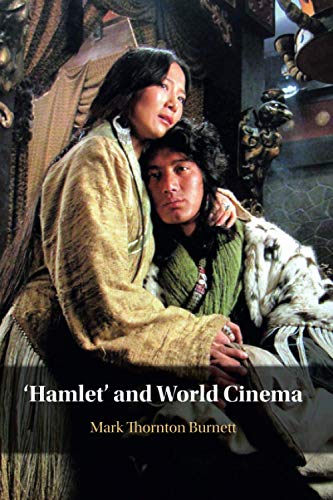
'Hamlet' and World Cinema by Mark Thornton Burnett
'Hamlet' and World Cinema reveals a rich history of cinematic production extending across the globe. Making a case for Hamlet as the world's most frequently filmed text, and using specially commissioned interviews with cast, directors and screenwriters, it discusses films from Africa, Asia, Europe, Latin America and the Middle East. The book argues that the play has been taken up by filmmakers world-wide to allegorise the energies, instabilities, traumas and expectations that have defined the twentieth and twenty-first centuries. In so doing, it rejects the Anglophone focus which has dominated criticism up to now and explores instead the multiple constituencies that have claimed Shakespeare's most celebrated work as their own. 'Hamlet' and World Cinema uncovers a vital part of the adaptation story. This book facilitates a fresh understanding of Shakespeare's cinematic significance and newly highlights Hamlet's political and aesthetic instrumentality in a vast range of local and global contexts.
''Hamlet' and World Cinema is a remarkable bookIn fact, there's nothing quite like it in the literature of Shakespeare on film. Burnett provides detailed cultural readings of thirty Hamlet films, each revealing something rich and strange about the country of origin and the moment of creation. His scholarship is astonishing as his analyses incorporate knowledge of each culture's history, politics, myths, film and stage traditions, language, as well as its appropriation of Shakespeare. He has a profound understanding of the myriad purposes Hamlet serves in these films as aesthetic object, political critique, cultural icon, or colonial intruder. The volume is not just a homage to Shakespeare's enduring impact on world cultures, but to the art of film itself.' Samuel Crowl, Ohio University
'(A) virtuosic study.' Sir Stanley Wells, Times Literary Supplement
'Graced with numerous stills and engaging writing, this book demands attention.' W. W. Dixon, Choice
'We are privileged to join the author on this journey.' Michael P. Jensen, The Shakespeare Newsletter
'The book 'makes a case for Hamlet as the world's most frequently filmed text' and shows how transpositions of the play to Brazilian book review 185 favelas, a compound in northern Ghana, and Tang Dynasty China (to name justthree) have illuminated the politics of race, gender, and class in these settings … 'Hamlet' and World Cinema privilege specific plays, allowing them to display the multiplicity these works have come to represent …' Sally Barnden, Shakespeare Bulletin
'(A) virtuosic study.' Sir Stanley Wells, Times Literary Supplement
'Graced with numerous stills and engaging writing, this book demands attention.' W. W. Dixon, Choice
'We are privileged to join the author on this journey.' Michael P. Jensen, The Shakespeare Newsletter
'The book 'makes a case for Hamlet as the world's most frequently filmed text' and shows how transpositions of the play to Brazilian book review 185 favelas, a compound in northern Ghana, and Tang Dynasty China (to name justthree) have illuminated the politics of race, gender, and class in these settings … 'Hamlet' and World Cinema privilege specific plays, allowing them to display the multiplicity these works have come to represent …' Sally Barnden, Shakespeare Bulletin
Mark Thornton Burnett is Professor of Renaissance Studies at Queen's University Belfast and Director of the Sir Kenneth Branagh Archive. He is the author of Masters and Servants in English Renaissance Drama and Culture (1997), Constructing 'Monsters' in Shakespearean Drama and Early Modern Culture (2002), Filming Shakespeare in the Global Marketplace (2nd edition, 2012) and Shakespeare and World Cinema (Cambridge, 2012). His co-edited publications include Shakespeare, Film, Fin de Siècle (2000), Screening Shakespeare in the Twenty-First Century (2006) and Filming and Performing Renaissance History (2011).
| SKU | Unavailable |
| ISBN 13 | 9781316501306 |
| ISBN 10 | 1316501302 |
| Title | 'Hamlet' and World Cinema |
| Author | Mark Thornton Burnett |
| Condition | Unavailable |
| Binding Type | Paperback |
| Publisher | Cambridge University Press |
| Year published | 2021-03-18 |
| Number of pages | 307 |
| Cover note | Book picture is for illustrative purposes only, actual binding, cover or edition may vary. |
| Note | Unavailable |