
An Analysis of Leon Festinger's A Theory of Cognitive Dissonance


An Analysis of Leon Festinger's A Theory of Cognitive Dissonance
Regular price
Checking stock...
Regular price
Checking stock...
The feel-good place to buy books
- Free UK delivery over £5
- 10% off preloved books when you join +Plus
- Buying preloved emits 46% less CO2 than new
- Give your books a new home - sell them back to us!
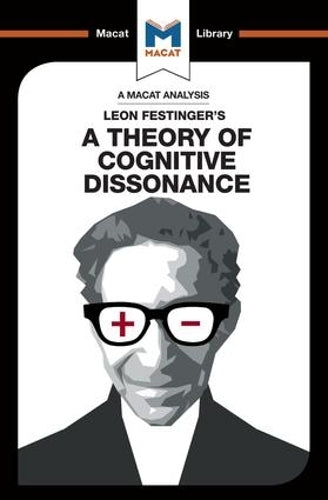
An Analysis of Leon Festinger's A Theory of Cognitive Dissonance by Camille Morvan
Leon Festinger’s 1957 A Theory of Cognitive Dissonance is a key text in the history of psychology – one that made its author one of the most influential social psychologists of his time. It is also a prime example of how creative thinking and problem solving skills can come together to produce work that changes the way people look at questions for good. Strong creative thinkers are able to look at things from a new perspective, often to the point of challenging the very frames in which those around them see things. Festinger was such a creative thinker, leading what came to be known as the “cognitive revolution” in social psychology. When Festinger was carrying out his research, the dominant school of thought – behaviorism – focused on outward behaviors and their effects. Festinger, however, turned his attention elsewhere, looking at “cognition:” the mental processes behind behaviors. In the case of “cognitive dissonance”, for example, he hypothesized that apparently incomprehensible or illogical behaviors might be caused by a cognitive drive away from dissonance, or internal contradiction. This perspective, however, raised a problem: how to examine and test out cognitive processes. Festinger’s book records the results of the psychological experiments he designed to solve that problem. The results helped prove the existence for what is now a fundamental theory in social psychology.Dr Camille Morvan is a pyschology researcher and founder of the psychological human resources company Goshaba. She has taught at Sciences Po in Paris and at Harvard University, as well as working at the École Normale Supérieure.
Dr Alexander O’Connor did his postgraduate work at the University of California, Berkeley, where he received a PhD for work on social and personality psychology.
| SKU | Unavailable |
| ISBN 13 | 9781912127818 |
| ISBN 10 | 1912127814 |
| Title | An Analysis of Leon Festinger's A Theory of Cognitive Dissonance |
| Author | Camille Morvan |
| Series | The Macat Library |
| Condition | Unavailable |
| Binding Type | Paperback |
| Publisher | Macat International Limited |
| Year published | 2017-07-15 |
| Number of pages | 96 |
| Cover note | Book picture is for illustrative purposes only, actual binding, cover or edition may vary. |
| Note | Unavailable |