


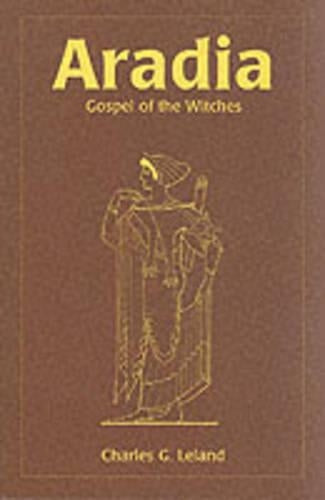
Aradia by Charles G Leland
Thank you for checking out this book by Theophania Publishing. We appreciate your business and look forward to serving you soon. We have thousands of titles available, and we invite you to search for us by name, contact us via our website, or download our most recent catalogues. Aradia, or the Gospel of the Witches is a book composed by the American folklorist Charles Leland, originally published in 1899. It contains what he believed was the religious text of a group of pagan witches in Tuscany, Italy, which documented their beliefs and rituals. Many historians and folklorists have disputed the existence of such a group. In the 20th century, the book was very influential in the development of the Neopagan religion of Wicca. The text is a composite of Leland's translation into English of an original Italian manuscript, the Vangelo (gospel) and Leland's other research on Italian folklore and traditions. Leland reported receiving the manuscript from his primary informant on Italian witchcraft beliefs, a woman Leland referred to as Maddalena. Leland had been informed of the Vangelo's existence in 1886, but he did not receive a copy until 1897. Its fifteen chapters portray the origins, beliefs, rituals, and spells of an Italian pagan witchcraft tradition. Leland's work remained obscure until the 1950s, when other theories about, and claims of, pagan witchcraft survivals began to be widely discussed. Aradia began to be examined within the wider context of such claims. Scholars are divided, with some dismissing Leland's assertion regarding the origins of the manuscript, and others arguing for its authenticity as a unique documentation of folk beliefs. Along with increased scholarly attention, Aradia came to play a special role in the history of Gardnerian Wicca and its offshoots, being used as evidence that pagan witchcraft survivals existed in Europe, and because a passage from the book's first chapter was used as a part of the religion's liturgy.
Charles Godfrey Leland (August 15, 1824 - March 20, 1903) was an American humorist and folklorist, born in Philadelphia, Pennsylvania. He was educated at Princeton University and in Europe. Leland worked in journalism, travelled extensively, and became interested in folklore and folk linguistics, publishing books and articles on American and European languages and folk traditions. By the end of his life shortly after the turn of the century, Leland had worked in a wide variety of trades, achieved recognition as the author of the comic Hans Breitmann's Ballads, fought in two conflicts, and had written what was to become a primary source text for Neopaganism half a century later, Aradia, or the Gospel of the Witches. Leland travelled widely, eventually settling in London. In his travels, he made a study of the Gypsies, on whom he wrote more than one book. Leland began to publish a number of books on ethnography, folklore and language. His fame during his lifetime rested chiefly on his comic Hans Breitmann's Ballads (1871), written in a combination of broken English and German (not to be confused, as it often has been, with Pennsylvania German). His writings on Algonquian and gypsy culture were part of the contemporary interest in pagan and Aryan traditions. He erroneously claimed to have discovered 'the fifth Celtic tongue': the form of Cant, spoken among Irish Travellers. He named it Shelta. Leland became president of the English Gypsy-Lore Society in 1888. Eleven years later Godfrey produced Aradia, or the Gospel of the Witches.
| SKU | Unavailable |
| ISBN 13 | 9780919345102 |
| ISBN 10 | 0919345107 |
| Title | Aradia |
| Author | Charles G Leland |
| Condition | Unavailable |
| Binding Type | Paperback |
| Publisher | Phoenix Publishing Inc.,U.S. |
| Year published | 1990-04-01 |
| Number of pages | 150 |
| Cover note | Book picture is for illustrative purposes only, actual binding, cover or edition may vary. |
| Note | Unavailable |