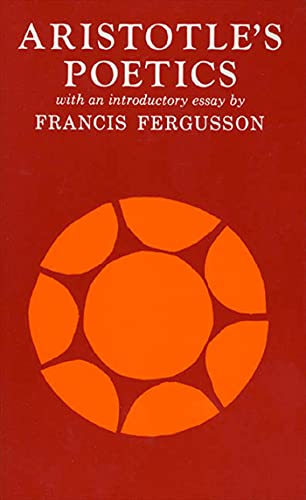
Aristotle's Poetics by Aristotle

Aristotle's Poetics by Aristotle

Regular price
Checking stock...
Regular price
Checking stock...
The feel-good place to buy books
  • Free UK delivery over £5
  • 10% off preloved books when you join +Plus
  • Buying preloved emits 46% less CO2 than new
  • Give your books a new home - sell them back to us!

Aristotle's Poetics by Aristotle

Introduced by Francis Fergusson, the Poetics, written in the fourth century B.C., is still an essential study of the art of drama, indeed the most fundamental one we have. It has been used by both playwrights and theorists of many periods, and interpreted, in the course of its two thousand years of life, in various ways. The literature which has accumulated around it is, as Mr. Fergusson points out, "full of disputes so erudite that the nonspecialist can only look on in respectful silence." But the Poetics itself is still with us, in all its suggestiveness, for the modern reader to make use of in his turn and for his own purposes.

Francis Fergusson's lucid, informative, and entertaining Introduction will prove invaluable to anyone who wishes to understand and appreciate the Poetics. Using Sophocles' Oedipus Rex, as Aristotle did, to illustrate his analysis, Mr. Fergusson pints out that Aristotle did not lay down strict rules, as is often thought: "The Poetics," he says, "is much more like a cookbook than it is like a textbook of elementary engineering." Read in this way, it is an essential guide not only to Sophoclean tragedy, but to the work of so modern a playwright as Bertolt Brecht, who considered his own "epic drama" the first non-Aristotelian form.

ARISTOTLE was born in the northern Greek town of Stagira in 384 B.C.E., where his father was the personal physician to the great-grandfather of Alexander the Great. At the age of eighteen Aristotle entered Plato's Academy and soon became recognized as its most important student. He remained under Plato's tutelage for nearly twenty years.

After his teacher's death in 347 B.C.E., Aristotle cultivated associations with other Academy students throughout Greece and Asia Minor. Then in 342 B.C.E., Aristotle was asked by King Philip II of Macedonia to become the tutor for his young son Alexander, who was later to become the conqueror of much of the known world at that time. The young prince remained under Aristotle's supervision until 336 B.C.E., when he acceded to the throne after his father's death. Two years later Aristotle returned to Athens and founded his own school, which he called the Lyceum. This intellectual center flourished during the years when Alexander the Great ruled Greece as part of his large empire. But upon Alexander's death in 323 B.C.E., Aristotle was charged with impiety by Athenians who resented his associations with the Macedonian conqueror. Rather than risk the same fate as Plato's mentor, Socrates, Aristotle fled to the city of Chalcis, where he died in 322 B.C.E.

Aristotle's interests, like those of Plato, were diverse and his writing cast its shadow on many fields, including logic, metaphysics, epistemology, ethics, politics, and the sciences. Among his most well-known works are: The Categories, The Prior and Posterior Analytics, The Physics, The Meta-physics, De Anima, The Nicomachean Ethics, and The Politics.

SKU Unavailable
ISBN 13 9780809005277
ISBN 10 0809005271
Title Aristotle's Poetics
Author Aristotle
Condition Unavailable
Binding Type Paperback
Publisher Hill And Wang
Year published 2003-01-20
Number of pages 128
Cover note Book picture is for illustrative purposes only, actual binding, cover or edition may vary.