


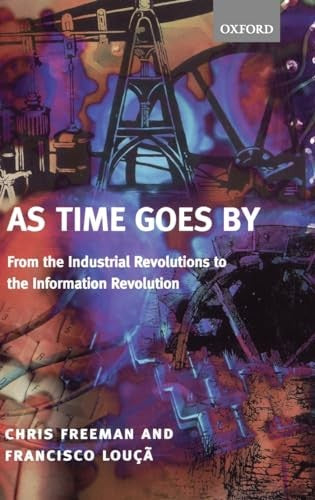
As Time Goes By by Chris Freeman
This title puts the computer revolution in the perspective of previous waves of technical change: steam-powered mechanization, electrification, and motorization. It argues for a theory of reasoned economic history which assigns a central place to these successive technological revolutions.
This is a very good and important book that is must reading for anyone interested in evolutionary economics and/or the relationship between history and economicsIn addition, you get a very well documented and argued interpretation of long run capitalist development from the industrial revolution to the present that will be a standard reference ... a first rate contribution to the discussion of how evolutionary economics should (may) develop. * Journal of Evolutionary Economics *
The book offers numerous insights into particular aspects of technological change ... Social theorists and policy advisors today need to be able to understand technological change in relation to cultural, political and economic life, and to situate contemporary developments in a longer term perspective. The authors provide a framework to do exactly that. Their book is a welcome demonstration of the usefulness of historical context for contemporary debates regarding science and technology policy. * Business History *
A thought-provoking work that is valuable for more than its detailed account of the technological revolutions that shape our economy today. By directing our attention to a perspective outside the current wave, it shapes our thinking about events inside the current wave. * Academy of Management Review *
This major contribution to economic history is the most impressive and convincing attempt I know to apply the concept of the 'long waves', a basic rhythm of historical development in the era of capitalism, to the entire stretch from eighteenth-century Lancashire to twenty-first-century Silicon Valley. It is also a call for economic history to escape from the handcuffs of narrow retrospective econometrics to the freedom of its vocation: understanding and explaining secular historical transformations. * Eric Hobsbawm FBA, American Academy of Arts & Sciences, Emeritus Professor of Social and Economic History, Birkbeck College; Author of The Age of Extremes: The Short Twentieth Century 1914-1991 *
The book offers numerous insights into particular aspects of technological change ... Social theorists and policy advisors today need to be able to understand technological change in relation to cultural, political and economic life, and to situate contemporary developments in a longer term perspective. The authors provide a framework to do exactly that. Their book is a welcome demonstration of the usefulness of historical context for contemporary debates regarding science and technology policy. * Business History *
A thought-provoking work that is valuable for more than its detailed account of the technological revolutions that shape our economy today. By directing our attention to a perspective outside the current wave, it shapes our thinking about events inside the current wave. * Academy of Management Review *
This major contribution to economic history is the most impressive and convincing attempt I know to apply the concept of the 'long waves', a basic rhythm of historical development in the era of capitalism, to the entire stretch from eighteenth-century Lancashire to twenty-first-century Silicon Valley. It is also a call for economic history to escape from the handcuffs of narrow retrospective econometrics to the freedom of its vocation: understanding and explaining secular historical transformations. * Eric Hobsbawm FBA, American Academy of Arts & Sciences, Emeritus Professor of Social and Economic History, Birkbeck College; Author of The Age of Extremes: The Short Twentieth Century 1914-1991 *
Chris Freeman is Emeritus Professor at SPRU, University of Sussex. After studying at the London School of Economics, he later took up the position of Research Fellow at the National Institute of Economic and Social Research, London (1959-66) before becoming Director of the Science Policy Research Unit at the University of Susex (1966-81). His most recent position was Visiting Professor at the University of Limburg in Maastricht (1986-96). He is the author of numerous books including 'The Economics of Industrial Innovation' (with L. Soete, Pinter, 1997); 'Work for All or Mass Unemployment: Computerised Technical Change into the 21st Century' (with L. Soete, Pinter, 1994); and 'Technology and Economic Performance: Lessons from Japan' (Pinter, 1987). Francisco Louçã is Professor of Economics in the Faculty of Economics and Management at the ISEG, Lisbon. He obtained his Ph.D. in Economics at the University of Lisbon under the supervision of Chris Freeman, subsequently publishing his thesis in both English and Portuguese ('Turbulence in Economics', Edward Elgar 1997). In 1999 he was elected Member of Parliament in Portugal, and serves in the Economic and Budgetary Commission.
| SKU | Unavailable |
| ISBN 13 | 9780199241071 |
| ISBN 10 | 0199241074 |
| Title | As Time Goes By |
| Author | Chris Freeman |
| Condition | Unavailable |
| Binding Type | Hardback |
| Publisher | Oxford University Press |
| Year published | 2001-02-15 |
| Number of pages | 424 |
| Cover note | Book picture is for illustrative purposes only, actual binding, cover or edition may vary. |
| Note | Unavailable |