


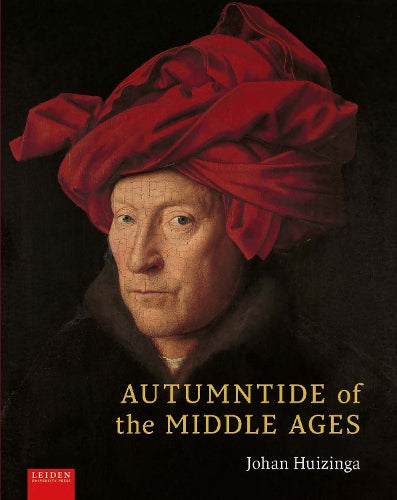
Autumntide of the Middle Ages by Graeme Small
So begins one of the most famous works of history ever published, Johan Huizinga's The Autumn of the Middle Ages. Few who have read this book in English realize that The Waning of the Middle Ages, the only previous translation, is vastly different from the original Dutch, and incompatible with all other European-language translations. Now, for the first time ever, the original version of this classic work has been translated into English. Herfsttij der Middeleeuwen, or The Autumn of the Middle Ages - the original title - is a brilliant portrait of life, thought, and art in fourteenth- and fifteenth- century France and the Netherlands. For Huizinga, this period marked not the birth of a dramatically new era in history, the Renaissance, but the fullest, ripest phase of medieval life and thought. Criticized both at home and in Europe for being old-fashioned and too literary when first published in 1919, the book is now recognized not only for its quality and richness as history, but also as a precursor to the Annales histoire des mentalites school of Marc Bloch and Lucien Febvre, two of the few reviewers who praised the book initially. In the 1924 translation, Fritz Hopman adapted, reduced, and altered the Dutch edition - softening Huizinga's often passionate arguments, dulling his nuances, and eliminating theoretical passages. He dropped many passages Huizinga had quoted in their original old French. Additionally, chapters are rearranged and redivided, all references are dropped, and mistranslations are introduced. This translation corrects such errors, recreating the second Dutch edition - which represents Huizinga's thinking at its most important stage - as closely as possible.Everything that was dropped or rearranged has been restored. Prose quotations appear in French, with translations printed at the bottom of the page. Mistranslations have been corrected. Payton and Mammitzsch also have added helpful material, including Huizinga's preface to the first and second Dutch editions (published in 1919 and 1921) and the one to the 1924 German translation, where he touches on the book's title and offers some thoughts on translations. Several notes clarify Huizinga's references to things which would be common knowledge only to Dutch readers. Huizinga frequently refers to paintings, sculptures, and carvings, some little known; this edition is the first in any language to include a full range of illustrations.Graeme Small is Professor of Medieval History at Durham University and the author of several books, including George Chastelain and the Shaping of Valois Burgundy as well as Court and Civic Society in the Burgundian Low Countries (with Andrew Brown) and Late Medieval France.
Anton van der Lem, a leading expert on Huizinga, has written or edited many articles and books, including the recently published Rereading Huizinga. It was at his suggestion that Leiden University Press decided to publish this first full-text translation from the original Dutch into English, and he set the standard with his Dutch centenary edition of Herfsttij. A fellow of Leiden University Libraries, he is the editor of https://huizinga-online.nl.
| SKU | Unavailable |
| ISBN 13 | 9789087283131 |
| ISBN 10 | 908728313X |
| Title | Autumntide of the Middle Ages |
| Author | Graeme Small |
| Condition | Unavailable |
| Binding Type | Hardback |
| Publisher | Leiden University Press |
| Year published | 2020-05-01 |
| Number of pages | 616 |
| Cover note | Book picture is for illustrative purposes only, actual binding, cover or edition may vary. |
| Note | Unavailable |