


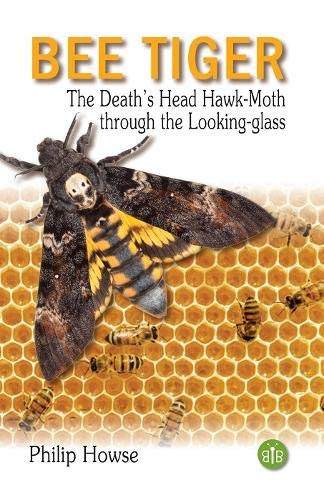
Bee Tiger by Philip Howse
The clear skull markings on the thorax of the large and impressive Death's Head Hawk-moth are truly fascinating, often perceived as a threat or leading to superstitious and mythological beliefs. Here the author, an authority in mimicry, discusses why we are so intrigued by these markings but also explains how other animals may perceive its form and behaviour. This moth has evolved to deceive its main predators, especially birds and bats, and to rob bees of their honey without getting stung, again by deceiving them of its true nature, with acoustic, visual and chemical signals in play. It is able to do this because of the obvious, but usually overlooked, fact that other animals live in a different sensory world to us, i.e. their perceptions are different.
A bizarre but revealing lens through which to view human life, death, our relationship to the natural world and its relationship to us- Charles Foster, prize-winning author of Being a Beast.
Philip Howse is Professor Emeritus in Biological Sciences at the University of Southampton. His main research, into insect behaviour and pest control without the use of synthetic insecticides, has taken him to many countries in the world and has led to the award of an OBE. He has received a number of awards for his recently published books on mimicry in butterflies and moths.
| SKU | Unavailable |
| ISBN 13 | 9781908241627 |
| ISBN 10 | 1908241624 |
| Title | Bee Tiger |
| Author | Philip Howse |
| Condition | Unavailable |
| Binding Type | Hardback |
| Publisher | Brambleby Books |
| Year published | 2021-06-28 |
| Number of pages | 160 |
| Cover note | Book picture is for illustrative purposes only, actual binding, cover or edition may vary. |
| Note | Unavailable |