


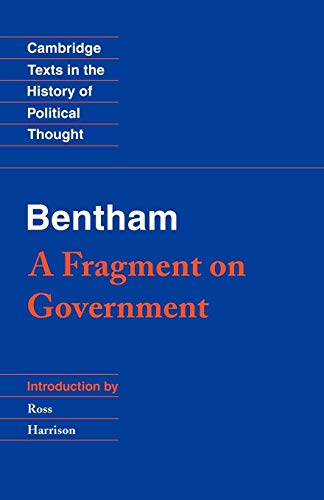
Bentham: A Fragment on Government by Jeremy Bentham
This volume makes available to a student readership one of the central texts in the utilitarian tradition, in the authoritative 1977 edition prepared by Professors Burns and Hart as part of Bentham's Collected works. A Fragment on Government is, as Ross Harrison observes in his introduction, a young man's work, and Bentham's exuberant prose reflects his own confidence that the Fragment 'was the first publication by which men at large were invited to break loose from the trammels of authority and ancestor-wisdom on the field of law'. Certain that history was on his side, Bentham sought to rid the world of the hideous mess wrought by legal obfuscation and confusion, and to transform politics into a rational scientific activity, premised on the hideous politics into a rational scientific activity, premised on the fundamental axiom that 'it is the greatest happiness of the greatest number that is the measure of right and wrong'. In the context of a European social and political order still based upon privilege and hereditary right, this was a profoundly subversive sentiment. This edition of the Fragment on Government contains several important students aids, including a guide to further reading and a chronology of the principal events in Bentham's life.
JEREMY BENTHAM was born in London on February 15, 1748, to a family of comfortable means. His was the life of a child prodigy who read Latin at three years of age and at twelve was enrolled in Oxford University, where he received his undergraduate degree at the age of sixteen. Thereafter, he studied law at Lincoln's Inn, Westminster. Inheritances from his parents afforded Bentham the opportunity to pursue a life of study and writing. While in his mid-forties, he dedicated himself to the critical analysis and reform of moral, political, religious, legal, educational, and economic institutions as they existed in England. Though he found the judicial system to be hypocritical and corrupt, Bentham's fascination with the fundamental ideals of the law steered him toward philosophy and science in an effort to develop standards that could ground the social order. His reformist tendencies proved to be a significant factor in the development of his now famous system of ethics known as utilitarianism, wherein human action was to be judged by the amount of pleasure and pain it produced. Bentham's published works include: A Fragment on Govern-ment (1776), An Introduction to the Principles of Morals and Legislation (1781), The Rationale of Judicial Evidence (edited by John Stuart Mill in 1825), and two volumes on Constitutional Code (ca. 1830). Bentham died in London on June 16, 1832.
| SKU | Unavailable |
| ISBN 13 | 9780521359290 |
| ISBN 10 | 0521359295 |
| Title | Bentham: A Fragment on Government |
| Author | Jeremy Bentham |
| Series | Cambridge Texts In The History Of Political Thought |
| Condition | Unavailable |
| Binding Type | Paperback |
| Publisher | Cambridge University Press |
| Year published | 1988-10-28 |
| Number of pages | 164 |
| Cover note | Book picture is for illustrative purposes only, actual binding, cover or edition may vary. |
| Note | Unavailable |