


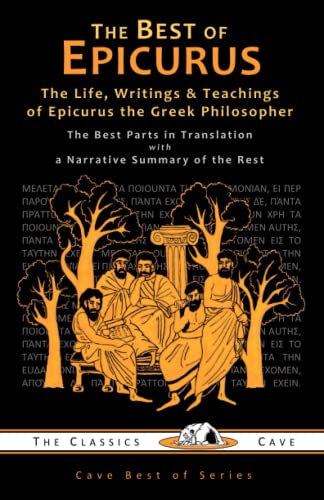
The Best of Epicurus by The Classics Cave
If you'd like to learn about the ancient Greek philosopher Epicurus and Epicureanism, then you'll want to grab a copy of The Best of Epicurus. Who was Epicurus? And what is Epicureanism? Contrary to what the modern term "epicurean" implies, ancient Greek Epicureanism was anything but "fond of indulgence and devoted to sensual enjoyment." In this modern sense, Epicurus himself (c. 341-271 BC) was no "epicure." Rather, fan of a simple diet of barley cakes and water, he boasted that, if he had these, he could compete with Zeus himself in terms of bliss. It has been said that Epicurus' "manner of life was much more like that of an abstemious monk." It's true. Epicurus proposed a simple, deliberate way of life that would help men and women live well and be happy. The Epicurean path influenced countless individuals in the ancient Greek and Roman worlds for nearly a millennium. It is The Classics Cave's hope that we may still benefit from Epicurus and his wisdom today. What is the Epicurean way of life? It is one centered on knowing well in order to live well. That-living well and being happy-is the goal. The means of achieving the goal are fairly straightforward however hard to practice. They are seeking wisdom. Sticking with the facts of reality. Desiring well. Enduring pain (if need be). Striving for self-sufficiency. Living simply. Cultivating the virtues. Nurturing friendship. With these, the long night of dread and anxiety begins to transition as the bright sun of tranquility appears. The Best of Epicurus presents Epicurus' own writings and teachings, as well as much of what remains about his life and philosophy from antiquity. It begins with an informative introduction, which, aside from explaining why we should care about Epicurus and the basic facts we should know about him, explores the big themes and ideas of his philosophy and way of life. The Best of Epicurus ends with a twelve-point Epicurean "Plan of Life," "Points of Wisdom from Epicurus," and three workbook or journal-like exercises for practice, along with "Other Matters of Interest Related to Epicurus," including a cast of significant ancient Epicureans, two maps, summaries of his major works, a glossary of pertinent Greek terms, and suggestions for further reading. If you are new to Epicurus and Epicureanism, you will come away understanding what this school of philosophy and way of life was all about. If you are already familiar with ancient Greek Epicureanism, we hope The Best of Epicurus will shed new light on what you know. If nothing else, you'll see how Epicurus and his philosophy are still relevant today.
EPICURUS (341 - 271 B.C.E.) was an Athenian philosopher of the Hellenistic period, who was born on the Aegean island of Samos off the coast of present-day Turkey. At age eighteen, he moved to Athens to complete a compulsory two-year term of military service and thereafter began studying philosophy under Nausiphanes of Teos. This teacher, at the time a follower of Democritus, proved to have considerable influence on Epicurus's thinking. Nonetheless, Epicurus later criticized some of the ideas of Nausiphanes and claimed to be mainly self-taught. After this period of study, he taught briefly in Mytilene on the island of Lesbos and then founded a school in Lampsacus on the Hellespont before returning to Athens in 306 B.C.E. There he purchased a house with a garden that became the site of a school and commune thereafter known as The Garden. It admitted both men and women, slave and free. Located midway between the famous Athenian Stoa and the Academy founded by Plato, the school and the philosophy taught there by Epicurus attracted many students and continued to be influential for centuries after his death.
| SKU | Unavailable |
| ISBN 13 | 9781943915101 |
| ISBN 10 | 1943915105 |
| Title | The Best of Epicurus |
| Author | The Classics Cave |
| Condition | Unavailable |
| Binding Type | Paperback |
| Publisher | Classics Cave |
| Year published | 2021-03-27 |
| Number of pages | 228 |
| Cover note | Book picture is for illustrative purposes only, actual binding, cover or edition may vary. |
| Note | Unavailable |