


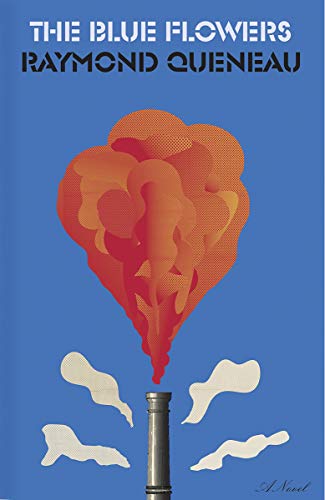
The Blue Flowers by Raymond Queneau
At his death in 1976, Raymond Queneau was one of France's most eminent men of letters--novelist, poet, essayist, editor, scientist, mathematician, and, more to the point, pataphysician. And only a pataphysician nurtured lovingly on surrealist excess could have come up with The Blue Flowers, Queneau's 1964 novel, now reissued as a New Directions Paperbook. To a pataphysician all things are equal, there is no improvement or progress in the human condition, and a message is an invention of the benighted reader, certainly not the author or his perplexing creations--the sweet, fennel-drinking Cidrolin and the rampaging Duke d'Auge. History is mostly what the duke rampages through--700 years of it at 175-year clips. He refuses to crusade, clobbers his king with the in toy of 1439--the cannon--dabbles in alchemy, and decides that those musty caves down at Altamira need a bit of sprucing up. Meanwhile, Cidrolin in the 1960s lolls on his barge moored along the Seine, sips essence of fennel, and ineffectually tries to catch the graffitist who nightly defiles his fence. But mostly he naps. Is it just a coincidence that the duke appears only when Cidrolin is dozing? And vice versa? In the tradition of Villon and C line, Queneau attempted to bring the language of the French streets into common literary usage, and his mad word-plays, bad puns, bawdy jokes, and anachronistic wackiness have been kept amazingly and glitteringly intact by the incomparable translator Barbara Wright.
"Raymond Queneau's The Blue Flowers: one of the weirdest and wildest rides in literatureWith as much colloquial language as Joyce and Pound, as much bawdy humor as Shakespeare and Chaucer, and as much puzzle-like wordplay as any of his fellow Oulipo brethren, Queneau gives us an idiosyncratic masterpiece to enjoy, to study, to wrestle with for the ages." -- Tyler Malone - Literary Hub
"Queneau’s role of combined scientist and pataphysician makes him seem more clearly than ever the forerunner of those other disintegrators of language: Ionesco and Beckett." -- The New York Times
"When it came to the novel, Raymond Queneau imagined a kind that would advance along strict compositional lines, like poetry or architecture, yet upset all expectation. Take The Blue Flowers, published in 1973 and now happily reissued by New Directions." -- The New Yorker
"In our century Queneau is a unique example of a wise and intelligent writer, who always goes against the grain of the dominant tendencies of his age and of French culture in particular—and he combines this with an endless need to invent and test possibilities. The Blue Flowers makes fun of history, denying its progress and reducing it to the substance of daily existence." -- Italo Calvino
"Queneau’s role of combined scientist and pataphysician makes him seem more clearly than ever the forerunner of those other disintegrators of language: Ionesco and Beckett." -- The New York Times
"When it came to the novel, Raymond Queneau imagined a kind that would advance along strict compositional lines, like poetry or architecture, yet upset all expectation. Take The Blue Flowers, published in 1973 and now happily reissued by New Directions." -- The New Yorker
"In our century Queneau is a unique example of a wise and intelligent writer, who always goes against the grain of the dominant tendencies of his age and of French culture in particular—and he combines this with an endless need to invent and test possibilities. The Blue Flowers makes fun of history, denying its progress and reducing it to the substance of daily existence." -- Italo Calvino
Raymond Queneau (1903-1976) is acknowledged as one of the most influential of modern French writers, having helped determine the shape of twentieth-century French literature, especially in his role with the Oulipo, a group of authors that includes Italo Calvino, Georges Perec, and Harry Mathews, among others. Barbara Wright has translated several Raymond Queneau novels; indeed, as John Updike wrote in The New Yorker, she "has waltzed around the floor with the Master so many times by now that she follows his quirky French as if the steps were in English." She has also translated works by Alain Robbe-Grillet, Robert Pinget, Nathalie Sarraute, and Marguerite Duras. She lives in London.
| SKU | Unavailable |
| ISBN 13 | 9780811227926 |
| ISBN 10 | 0811227928 |
| Title | The Blue Flowers |
| Author | Raymond Queneau |
| Condition | Unavailable |
| Binding Type | Paperback |
| Publisher | New Directions Publishing Corporation |
| Year published | 2018-09-21 |
| Number of pages | 244 |
| Cover note | Book picture is for illustrative purposes only, actual binding, cover or edition may vary. |
| Note | Unavailable |