


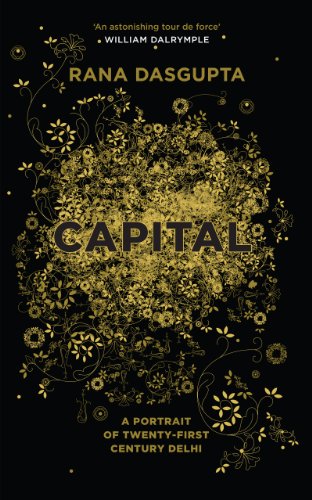
Capital by Rana Dasgupta
The transformation of Delhi into a twenty-first century metropolis is an intoxicating, at times terrifying story - and it has repercussions not only for India, but for everybody's future.
A beautifully written portrait of a corrupt, violent and traumatised city growing so fast it is almost unrecognisable to its own inhabitantsAn astonishing tour de force by a major writer at the peak of his powers -- WILLIAM DALRYMPLE
A terrific portrait of Delhi right now and hits a lot of nails on the head -- SALMAN RUSHDIE * * Vogue * *
Lyrical and haunting * * International New York Times * *
Achingly beautiful . . . and cleverly tangential * * Financial Times * *
Intense, lyrical, erudite and powerful * * Observer * *
Important . . . His lyrical encounters with a wide range of modern Delhiites reveal a novelist's ear and are beautifully sketched * * Telegraph * *
Dasgupta peels back the layers of denial with insight, humanity and beautiful writing. He exposes festering wounds buts succeeds in fascinating rather than repelling * * The Times * *
A remarkable and exhaustive account * * Independent * *
Personal, original and vivid * * New Internationalist * *
A remarkably elegant work whose rich style and sweep often brings to mind V S Naipaul's A Million Mutinies Now * * New Statesman * *
Dasgupta's combination of reportage, political critique and oral history is mordant rather than dyspeptic, sorrowful rather than castigatory. But what makes it more than a local study, what makes it so haunting, is that its textured, tart accounts of the privatisation of public space, of the incestuous relationship between the political and business classes, of the precarity that renders daily life so fraught all apply as much to Britain and the west as they do to the Indian capital * * Guardian * *
Capital is constructed around a series of mesmerising interviews . . . Among many lively episodes in Dasgupta's appropriately large, sprawling and populous book is one describing the experience of driving in Delhi * * Spectator * *
Rana Dasgupta is the most unexpected and original Indian writer of his generation -- SALMAN RUSHDIE
[Dasgupta has] a gift for sentences of lancing power and beauty * * New Yorker * *
Dasgupta's eye is keen, and his sensitivity to small moments takes this extraordinary, tender book linger in the mind like a series of striking short stories. In Delhi, ruined, embattled, and alarmingly mutant, he sees the globalised city of the future * * Prospect * *
A terrific portrait of Delhi right now and hits a lot of nails on the head -- SALMAN RUSHDIE * * Vogue * *
Lyrical and haunting * * International New York Times * *
Achingly beautiful . . . and cleverly tangential * * Financial Times * *
Intense, lyrical, erudite and powerful * * Observer * *
Important . . . His lyrical encounters with a wide range of modern Delhiites reveal a novelist's ear and are beautifully sketched * * Telegraph * *
Dasgupta peels back the layers of denial with insight, humanity and beautiful writing. He exposes festering wounds buts succeeds in fascinating rather than repelling * * The Times * *
A remarkable and exhaustive account * * Independent * *
Personal, original and vivid * * New Internationalist * *
A remarkably elegant work whose rich style and sweep often brings to mind V S Naipaul's A Million Mutinies Now * * New Statesman * *
Dasgupta's combination of reportage, political critique and oral history is mordant rather than dyspeptic, sorrowful rather than castigatory. But what makes it more than a local study, what makes it so haunting, is that its textured, tart accounts of the privatisation of public space, of the incestuous relationship between the political and business classes, of the precarity that renders daily life so fraught all apply as much to Britain and the west as they do to the Indian capital * * Guardian * *
Capital is constructed around a series of mesmerising interviews . . . Among many lively episodes in Dasgupta's appropriately large, sprawling and populous book is one describing the experience of driving in Delhi * * Spectator * *
Rana Dasgupta is the most unexpected and original Indian writer of his generation -- SALMAN RUSHDIE
[Dasgupta has] a gift for sentences of lancing power and beauty * * New Yorker * *
Dasgupta's eye is keen, and his sensitivity to small moments takes this extraordinary, tender book linger in the mind like a series of striking short stories. In Delhi, ruined, embattled, and alarmingly mutant, he sees the globalised city of the future * * Prospect * *
Rana Dasgupta won the 2010 Commonwealth Writers' Prize for Best Book for his debut novel Solo. He is also the author of a collection of urban folktales, Tokyo Cancelled, which was shortlisted for the 2005 John Llewellyn Rhys Prize. Capital is his first work of non-fiction. Born in Canterbury in 1971, he now lives in Delhi.
| SKU | Unavailable |
| ISBN 13 | 9780857860026 |
| ISBN 10 | 085786002X |
| Title | Capital |
| Author | Rana Dasgupta |
| Condition | Unavailable |
| Binding Type | Hardback |
| Publisher | Canongate Books |
| Year published | 2014-03-06 |
| Number of pages | 512 |
| Prizes | Winner of Ryszard Kapuscinski Award for Literary Reportage 2017 (UK), Short-listed for Ondaatje Prize 2015 (UK), Short-listed for The Orwell Prize for Books 2015 (UK), Long-listed for The Orwell Prize for Books 2015 (UK) |
| Cover note | Book picture is for illustrative purposes only, actual binding, cover or edition may vary. |
| Note | Unavailable |