


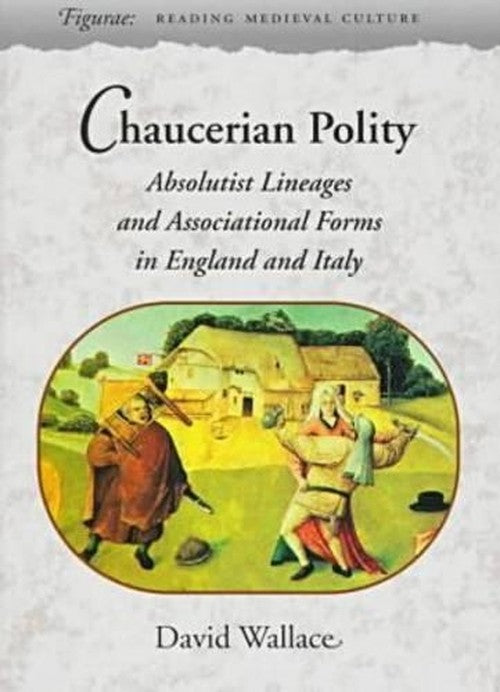
Chaucerian Polity by David Wallace
Chaucer's encounters with the great Trecento authors Dante, Boccaccio, and Petrarch facilitate the testing and dismantling of time-honored terms such as medieval, Renaissance, and humanism. The author argues that no magic curtain separated medieval London and Westminster from Renaissance Florence and Milan; as a result of his Italian journeys, all sites were interlinked for Chaucer as parts of a transnational nexus of capital, cultural, mercantile, and military exchange. In his travels, Chaucer was exposed to the Trecento's most crucial material and ideological conflict, that between a fully developed and highly inclusive associational polity (Florence) and the first, prototypically imperfect, absolutist state of modern times (Lombardy). Chaucer's Canterbury Tales, the author proposes, explores both the establishment and maintenance of generously inclusive associational forms (the pilgrim compagnye) and the dangers of despotism (most famously exemplified by tyraunts of Lombardye). The Tales thus speaks to political tensions experienced in Ricardian, or fourteenth-century, England that find resolution only in the sixteenth century.
'No other book I have read brings to life so vividly the European world in which Chaucer lived and wroteChaucerian Polity is simply the most important contribution to Chaucer studies in decades.' Terry Jones
| SKU | Unavailable |
| ISBN 13 | 9780804736619 |
| ISBN 10 | 0804736618 |
| Title | Chaucerian Polity |
| Author | David Wallace |
| Series | Figurae: Reading Mediaeval Culture S |
| Condition | Unavailable |
| Binding Type | Paperback |
| Publisher | Stanford University Press |
| Year published | 2005-12-03 |
| Number of pages | 578 |
| Cover note | Book picture is for illustrative purposes only, actual binding, cover or edition may vary. |
| Note | Unavailable |