


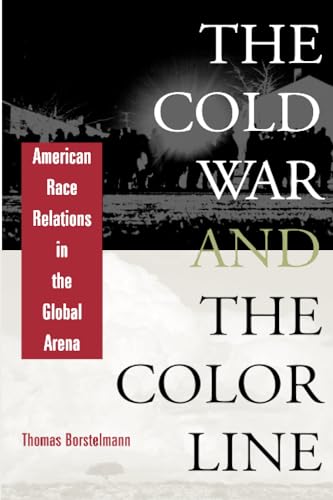
The Cold War and the Color Line by Thomas Borstelmann
The Cold War and the Color Line is the first comprehensive examination of how the Cold War intersected with the final destruction of global white supremacy. Thomas Borstelmann pays close attention to the two SouthsSouthern Africa and the American Southas the primary sites of white authoritys last stand.
[Borstelmann traces] the constellation of racial challenges each administration faced (focusing particularly on African affairs abroad and African American civil rights at home), rather than highlighting the crises that made headlines… By avoiding the crutch of ‘turning points’ for storytelling convenience, he makes a convincing case that no single event can be untied from a constantly thickening web of connections among civil rights, American foreign policy, and world affairs-- Jesse Berrett * Village Voice *
Borstelmann…analyzes the history of white supremacy in relation to the history of the Cold War, with particular emphasis on both African Americans and Africa. In a book that makes a good supplement to Mary Dudziak’s Cold War Civil Rights, he dissects the history of U.S. domestic race relations and foreign relations over the past half-century… This book provides new insights into the dynamics of American foreign policy and international affairs and will undoubtedly be a useful and welcome addition to the literature on U.S. foreign policy and race relations. Recommended. -- Edward G. McCormack * Library Journal *
In rich, informing detail enlivened with telling anecdote, Cornell historian Borstelmann unites under one umbrella two commonly separated strains of the U.S. post-WWII experience: our domestic political and cultural history, where the Civil Rights movement holds center stage, and our foreign policy, where the Cold War looms largest… No history could be more timely or more cogent. This densely detailed book, wide ranging in its sources, contains lessons that could play a vital role in reshaping American foreign and domestic policy. * Publishers Weekly *
Borstelmann…analyzes the history of white supremacy in relation to the history of the Cold War, with particular emphasis on both African Americans and Africa. In a book that makes a good supplement to Mary Dudziak’s Cold War Civil Rights, he dissects the history of U.S. domestic race relations and foreign relations over the past half-century… This book provides new insights into the dynamics of American foreign policy and international affairs and will undoubtedly be a useful and welcome addition to the literature on U.S. foreign policy and race relations. Recommended. -- Edward G. McCormack * Library Journal *
In rich, informing detail enlivened with telling anecdote, Cornell historian Borstelmann unites under one umbrella two commonly separated strains of the U.S. post-WWII experience: our domestic political and cultural history, where the Civil Rights movement holds center stage, and our foreign policy, where the Cold War looms largest… No history could be more timely or more cogent. This densely detailed book, wide ranging in its sources, contains lessons that could play a vital role in reshaping American foreign and domestic policy. * Publishers Weekly *
Thomas Borstelmann is Elwood N. and Katherine Thompson Distinguished Professor of Modern World History, University of Nebraska.
| SKU | Unavailable |
| ISBN 13 | 9780674012387 |
| ISBN 10 | 0674012380 |
| Title | The Cold War and the Color Line |
| Author | Thomas Borstelmann |
| Condition | Unavailable |
| Binding Type | Paperback |
| Publisher | Harvard University Press |
| Year published | 2003-09-15 |
| Number of pages | 384 |
| Prizes | Nominated for Robert H. Ferrell Book Prize 2002, Nominated for Ellis W. Hawley Prize 2002, Nominated for Douglas Dillon Award 2002, Nominated for James A. Rawley Prize 2003, Nominated for Lionel Gelber Prize 2003, Nominated for Arthur Ross Book Award 2002, Nominated for Gladys M. Kammerer Award 2002, Nominated for Woodrow Wilson Foundation Award 2002, Nominated for Best Book Award in Race, Ethnicity, and Politics 2002, Nominated for Richard E. Neustadt Best Book Award 2002 |
| Cover note | Book picture is for illustrative purposes only, actual binding, cover or edition may vary. |
| Note | Unavailable |