
The Collected Works of Jeremy Bentham: An Introduction to the Principles of Morals and Legislation


The feel-good place to buy books
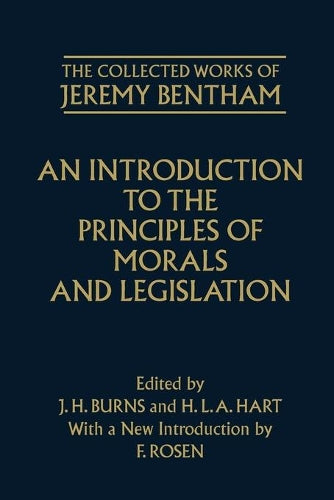
The Collected Works of Jeremy Bentham: An Introduction to the Principles of Morals and Legislation by Jeremy Bentham
The new critical edition of the works and correspondence of Jeremy Bentham (1748-1832) is being prepared and published under the supervision of the Bentham Committee of University College London. In spite of his importance as jurist, philosopher, and social scientist, and leader of the Utilitarian reformers, the only previous edition of his works was a poorly edited and incomplete one brought out within a decade or so of his death. Eight volumes of the new Collected Works, five of correspondence, and three of writings on jurisprudence, appeared between 1968 and 1981, published by the Athlone Press. Further volumes in the series since then are published by Oxford University Press. The overall plan and principles of the edition are set out in the General Preface to The Correspondence of Jeremy Bentham, vol. 1, which was the first volume of the Collected Works to be published.An Introduction to the Principles of Morals and Legislation, Jeremy Bentham's best-known work, is a classic text in modern philosophy and jurisprudence. First published in 1789, it contains the important statement of the foundations of utilitarian philosophy and a pioneering study of crime and punishment, both of which remain at the heart of contemporary debates in moral and political philosophy, economics, and legal theory. Printed here in full is the definitive edition, edited by the distinguished scholars J. H. Burns and H. L. A. Hart. An introductory essay by Hart, first published in 1982 and a widely acknowledged classic in its own right, is reprinted here. It contains an important analysis of Bentham's principle of utility, theory of action, and an account of the relationship between law and morality.A new introduction by the leading Bentham scholar F. Rosen, specially written for this Clarendon Paperback edition, provides students with a helpful survey of Bentham's main ideas and an extensive bibliographical study of recent critical work on Bentham. Professor Rosen's essay also contains a new analysis of the principle of utility in Bentham's philosophy which is compared with its use in Hume and J. S. Mill.JEREMY BENTHAM was born on February 15, 1748, in London, to a wealthy family. His was the life of a child genius who began reading Latin at the age of three and enrolled at Oxford University at the age of twelve, receiving his undergraduate degree at the age of sixteen. After that, he went to Lincoln's Inn, Westminster, to study law. Bentham was able to pursue a life of study and writing thanks to inheritances from his parents. He devoted himself to the critical investigation and reform of moral, political, religious, legal, educational, and economic institutions in England when in his mid-forties.
Bentham's fascination with the underlying ideals of the law led him to philosophy and science in an attempt to construct standards that could base the social order, despite the fact that he believed the legal system to be hypocritical and corrupt. His reforming tendencies were a key component in the formation of utilitarianism, his now-famous ethical framework in which human conduct was judged by the amount of pleasure and misery it created. A Fragment on Government (1776), An Introduction to the Principles of Morals and Laws (1781), The Logic of Judicial Evidence (edited by John Stuart Mill in 1825), and two volumes on Constitutional Code (ca. 1825) are among Bentham's published works. Bentham died on June 16, 1832, in London.
| SKU | Unavailable |
| ISBN 13 | 9780198205166 |
| ISBN 10 | 0198205163 |
| Title | The Collected Works of Jeremy Bentham: An Introduction to the Principles of Morals and Legislation |
| Author | Jeremy Bentham |
| Series | The Collected Works Of Jeremy Bentham |
| Condition | Unavailable |
| Binding Type | Paperback |
| Publisher | Oxford University Press |
| Year published | 1996-02-29 |
| Number of pages | 456 |
| Cover note | Book picture is for illustrative purposes only, actual binding, cover or edition may vary. |
| Note | Unavailable |