


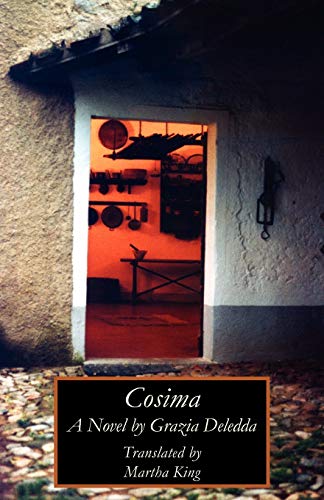
Cosima by Grazia Deledda
Cosima tells the story of an aspiring writer growing up in Nuoro, Sardinia during the last decades of the nineteenth century when formal education for women was rare and literary careers unheard-of. Based on Deledda's own life, the work describes a young woman's struggle against the dismay and disapproval of her family and friends at her creative ambitions. Yet it also reads like a charming fable with details of family life, rural traditions and wild bandits, and it is as much a novel of memory as of character or action. Deledda's characters are poor country folk driven by some predetermined force. Their loves are tragic, their lives as hard and as rigidly controlled as nature itself in the hills of Sardinia. Deledda creates memorable figures who play out their lives against this backdrop of mountains and bare plains, sheepfolds and vineyards. Shimmering in the distance is the sea and escape - for a few - to the Continent or America. In 1926 Grazia Deledda became the second woman and the second Italian to receive the Nobel Prize for Literature. She wrote thirty-three novels, including Reeds in the Wind, and many books of short stories, almost all set on Sardinia. Her work has become well known to English-speaking readers through Martha King's translations for Italica Press.Nacque in Nuoro, the youngest of six children in a loving family. Giovanni Antonio, the father, was an imprenditor and a president, as well as an improvised poet and the mayor of Nuoro in 1892. Francesca Cambosu, the mother, was a devout Catholic who raised her children with extreme moral rigor. Following her attendance at elementary schools, Grazia Deledda was followed privately by a professor who was a guest of one of her parents and who taught her Italian, Latin, and French. The customs of the time did not permit girls to receive a comprehensive education beyond primary school and, in general, regular studies.
Following that, autodidatta approfondi gli studi letterari. Crucial for Grazia Deledda's lettering training in her early years as a writer was her friendship with sassarese writer, archivist, and storico dilettante Enrico Costa, who recognized her brilliance for the first time. Esordi began her career as a writer with a few stories published in the magazine L'ultima moda at a time when she was still attached to her poetical narrativa. Trevisani's 1890 publication, Nell'azzurro, can be considered his esordio work.
Still straddling the line between poetic and narrative expression, Paesaggi, published by Speirani in 1896, is one of the first works. In the year 1900, Madesani's sposo Palmiro Madesani, a member of the Ministry of Finance, is known in Cagliari; in October 1899, the scrittrice moves to Rome, and after the publication of Anime oneste (1895) and Il vecchio della montagna (1900), as well as collaborations on the riviste La Sardegna, Piccola rivista, and Nuova Antologia, the Elias Portolu publishes Cenere in 1904, L'edera in 1908, Sino al confine in 1911, Colombi e sparvieri in 1912, Canne al vento in 1913, L'incendio nell'oliveto in 1918, and Il Dio dei venti in 1922. Eleonora Duse portrayed Eleonora Cenere in the film Da Cenere.
| SKU | Unavailable |
| ISBN 13 | 9780934977067 |
| ISBN 10 | 0934977062 |
| Title | Cosima |
| Author | Grazia Deledda |
| Condition | Unavailable |
| Binding Type | Paperback |
| Publisher | Italica Press |
| Year published | 1988-12-31 |
| Number of pages | 160 |
| Cover note | Book picture is for illustrative purposes only, actual binding, cover or edition may vary. |
| Note | Unavailable |