


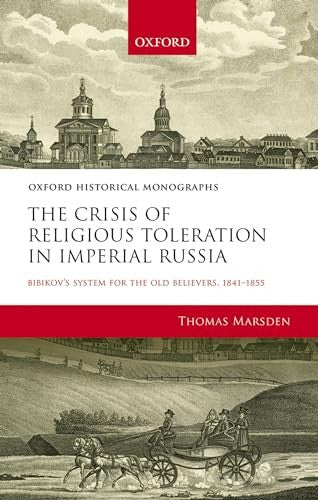
The Crisis of Religious Toleration in Imperial Russia by Thomas Marsden
This book is about an unprecedented attempt by the government of Russia's Tsar Nicholas I (1825-1855) to eradicate what was seen as one of the greatest threats to its political security: the religious dissent of the Old Believers. The Old Believers had long been reviled by the ruling Orthodox Church, for they were the largest group of Russian dissenters and claimed to be the guardians of true Orthodoxy; however, their industrious communities and strict morality meant that the civil authorities often regarded them favourably. This changed in the 1840s and 1850s when a series of remarkable cases demonstrated that the existing restrictions upon the dissenters' religious freedoms could not suppress their capacity for independent organisation. Finding itself at a crossroads between granting full toleration, or returning to the fierce persecution of earlier centuries, the tsarist government increasingly inclined towards the latter course, culminating in a top secret 'system' introduced in 1853 by the Minister of Internal Affairs Dmitrii Bibikov. The operation of this system was the high point of religious persecution in the last 150 years of the tsarist regime: it dissolved the Old Believers' religious gatherings, denied them civil rights, and repressed their leading figures as state criminals. It also constituted an extraordinary experiment in government, instituted to deal with a temporary emergency. Paradoxically the architects of this system were not churchmen or reactionaries, but representatives of the most progressive factions of Nicholas's bureaucracy. Their abandonment of religious toleration on grounds of political intolerability reflected their nationalist concerns for the future development of a rapidly changing Russia. The system lasted only until Nicholas's death in 1855; however, the story of its origins, operation, and collapse, told for the first time in this study, throws new light on the religious and political identity of the autocratic regime and on the complexity of the problems it faced.
An absolute must for those studying Russian religion, politics and society* James M. White (Ural Federal University), European History Quarterly, Vol. 47 *
Marsden has made a major contribution to understanding the history of Russian state policy toward religion in general and the Old Belief in particular. A delight to read, this book offers an important perspective on the dilemmas that faced the modernizing Russian state and its enlightened bureaucrats in the mid-19th century. Political scientists and historians of Russia and Europe interested in the development of the secular state will find it stimulating and useful. * Eugene Clay, Reviews in History *
Marsden's book has numerous virtues. Firstly, it is necessary to note the vast amount of archival work conducted by the author and the rigorous use of published sources. Second, Marsden succeeds in placing his relatively narrow theme into a wider context, discussing as he does questions relating to religious toleration, international relations, nation building, and state formation ... the material presented in this book will serve as an excellent basis for further research on the history of the Russian Empire's confessional system: no less than this, the author's conceptualization is undoubtedly a wonderful start to fruitful scholarly debate on this subject. * Numen *
Scholars of religion and especially dissent in Russia, as well as those focusing on governance and state ideology, will benefit handsomely from reading this well-researched book. * Paul W. Werth, Slavonic and East European Review, *
Marsden has made a major contribution to understanding the history of Russian state policy toward religion in general and the Old Belief in particular. A delight to read, this book offers an important perspective on the dilemmas that faced the modernizing Russian state and its enlightened bureaucrats in the mid-19th century. Political scientists and historians of Russia and Europe interested in the development of the secular state will find it stimulating and useful. * Eugene Clay, Reviews in History *
Marsden's book has numerous virtues. Firstly, it is necessary to note the vast amount of archival work conducted by the author and the rigorous use of published sources. Second, Marsden succeeds in placing his relatively narrow theme into a wider context, discussing as he does questions relating to religious toleration, international relations, nation building, and state formation ... the material presented in this book will serve as an excellent basis for further research on the history of the Russian Empire's confessional system: no less than this, the author's conceptualization is undoubtedly a wonderful start to fruitful scholarly debate on this subject. * Numen *
Scholars of religion and especially dissent in Russia, as well as those focusing on governance and state ideology, will benefit handsomely from reading this well-researched book. * Paul W. Werth, Slavonic and East European Review, *
Thomas Marsden read History at St Edmund Hall, Oxford, before receiving his DPhil as the Peter Storey Scholar at Balliol College. He is now a British Academy Postdoctoral Fellow at the School of Slavonic and East European Studies, University College London.
| SKU | Unavailable |
| ISBN 13 | 9780198746362 |
| ISBN 10 | 0198746369 |
| Title | The Crisis of Religious Toleration in Imperial Russia |
| Author | Thomas Marsden |
| Series | Oxford Historical Monographs |
| Condition | Unavailable |
| Binding Type | Hardback |
| Publisher | Oxford University Press |
| Year published | 2015-09-24 |
| Number of pages | 298 |
| Cover note | Book picture is for illustrative purposes only, actual binding, cover or edition may vary. |
| Note | Unavailable |