


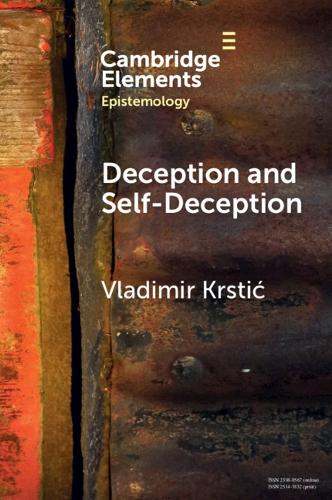
Deception and Self-Deception by Vladimir Krstić
Received theories of self-deception are problematic. The traditional view, according to which self-deceivers intend to deceive themselves, generates paradoxes: you cannot deceive yourself intentionally because you know your own plans and intentions. Non-traditional views argue that self-deceivers act intentionally but deceive themselves unintentionally or that self-deception is not intentional at all. The non-traditional approaches do not generate paradoxes, but they entail that people can deceive themselves by accident or by mistake, which is controversial. The author argues that a functional analysis of deception solves these problems. On the functional view, a certain thing is deceptive if and only if its function is to mislead; hence, while (self-)deception may but need not be intended, it is never accidental or a mistake. Also, self-deceivers need not benefit from deception and they need not end up with epistemically unjustified beliefs; rather, they must 'not be themselves'. Finally, self-deception need not be adaptive.| SKU | Unavailable |
| ISBN 13 | 9781009362894 |
| ISBN 10 | 1009362895 |
| Title | Deception and Self-Deception |
| Author | Vladimir Krsti? |
| Series | Elements In Epistemology |
| Condition | Unavailable |
| Binding Type | Paperback |
| Publisher | Cambridge University Press |
| Year published | 2025-07-31 |
| Number of pages | 75 |
| Cover note | Book picture is for illustrative purposes only, actual binding, cover or edition may vary. |
| Note | Unavailable |