


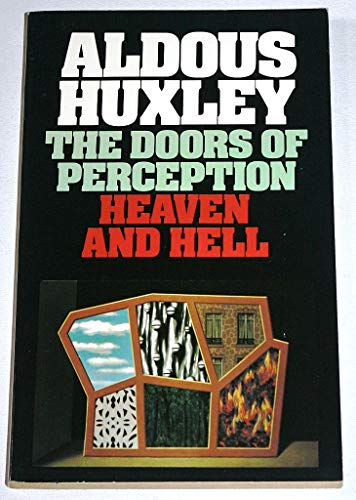
The Doors of Perception by Aldous Huxley
In 1953, in the presence of an investigator, he took four-tenths of a gramme of mescalin, sat down and waited to see what would happen. When he opened his eyes everything, from the flowers in a vase to the folds in his grey flannel trousers, was transformed. "Red books like rubies, emerald books, books of agate and aquamarien. I was not looking now at an unusual flower arrangement. I was seeing what Adam had seen on the morning of his creation - the miracle, moment by moment, of naked existence." Huxley described his new "sacramental vision of reality" and the liberating potential of hallucinogenic drugs in his 1954 essay, "The Doors of Perception" and its 1956 sequel, "Heaven and Hell". These writings were crucial to the brave new dawn of the psychedelic 1960s.Aldous Huxley (1894-1963) was an English writer and philosopher. Born in Godalming, Huxley--the grandson of famed zoologist Thomas Henry Huxley and grandnephew of poet and critic Matthew Arnold--was raised in a family with wide-ranging intellectual interests. He attended Eton College as a youth before enrolling at Balliol College, Oxford, where he studied English literature and edited Oxford Poetry. An eye disease Huxley contracted around this time ended his hopes of studying medicine and serving in the Great War, and he instead graduated with a BA in 1916. After a brief stint teaching French at Eton College--among his pupils was Eric Blair, later to write under the pen-name George Orwell--and several years working for Brynner and Mond, a chemical company, Orwell began writing in earnest. The first decade of his career saw him publish four novels, including Crome Yellow (1921) and Point Counter Point (1928). These early works of social satire, inspired in part by his acquaintance with members of the Bloomsbury Group, including Bertrand Russell and Alfred North Whitehead, as well as by his friendship with D.H. Lawrence, gave way in the 1930s to more serious works of fiction, including the dystopian classic Brave New World (1932) and Eyeless in Gaza (1936), a novel with pacifist themes. In 1937, Huxley moved with his wife, Maria, and son, Matthew, to Los Angeles, where he would live, apart from a period in Taos, New Mexico, for the rest of his life. Over the next three decades, Huxley continued to publish award-winning works of fiction, devoted himself to Vedantism, and wrote works on mysticism, Eastern and Western philosophies, and the use of psychedelic drugs.
| SKU | Unavailable |
| ISBN 13 | 9780586044377 |
| ISBN 10 | 058604437X |
| Title | The Doors of Perception |
| Author | Aldous Huxley |
| Series | Flamingo Modern Classics |
| Condition | Unavailable |
| Binding Type | Paperback |
| Publisher | HarperCollins Publishers |
| Year published | 1977-02-17 |
| Number of pages | 144 |
| Cover note | Book picture is for illustrative purposes only, actual binding, cover or edition may vary. |
| Note | Unavailable |