


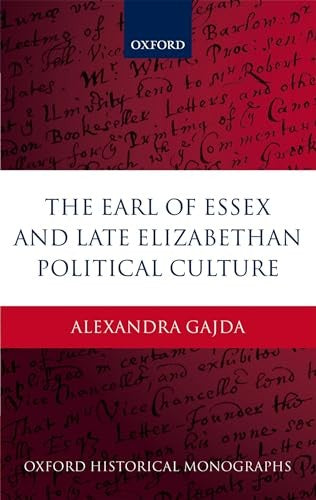
The Earl of Essex and Late Elizabethan Political Culture by Alexandra Gajda
In sixteenth-century England Robert Devereux, 2nd earl of Essex, enjoyed great domestic and international renown as a favourite of Elizabeth I. He was a soldier and a statesman of exceptionally powerful ambition. After his disastrous uprising in 1601 Essex fell from the heights of fame and favour, and ended his life as a traitor on the scaffold. This interdisciplinary account of the political culture of late Elizabethan England explores the ideological contexts of Essex's extraordinary career and fall from grace, and the intricate relationship between thought and action in Elizabethan England. By the late sixteenth century, fundamental political models and vocabularies that were employed to legitimise the Elizabethan polity were undermined by the strains of war, the ambivalence that many felt towards the church, continued uncertainty over the succession, and the perceived weaknesses of the rule of the aging Elizabeth. Essex's career and revolt threw all of these strains into relief. Alexandra Gajda examines the attitude of the earl and his followers to war, religion, the structures of the Elizabethan polity, and Essex's role within it. She also explores the classical and historical scholarship prized by Essex and his associates that gave shape and meaning to the earl's increasingly fractured relationship with the Queen and regime. She addresses contemporary responses to the earl, both positive and negative, and the earl's wider impact on political culture. Political and religious ideas in late sixteenth-century England had an important impact on political events in early modern England, and played a vital role in shaping the rise and fall of Essex's career.
a nuanced study, essential reading on the rebellion and its aftermath; the confused and often terrifying political culture of late Elizabethan England; and the varied and over-confident followers who flocked to the Earl, believing that he had the power to solve their problems* Andrew Hadfield, Times Literary Supplement *
... a must-read for everyone interested in late Elizabethan history and political culture. * Kinga Földváry, Sixteenth Century Journal *
an intellectual analysis of Essex's career, one based on a formidable range of research in a range of aspects of sixteenth-century political and intellectual history. It seems unlikely that a better analysis of this topic will be produced. * Neil Younger, English Historical Review *
... a must-read for everyone interested in late Elizabethan history and political culture. * Kinga Földváry, Sixteenth Century Journal *
an intellectual analysis of Essex's career, one based on a formidable range of research in a range of aspects of sixteenth-century political and intellectual history. It seems unlikely that a better analysis of this topic will be produced. * Neil Younger, English Historical Review *
Alexandra Gajda was a student at New College, Oxford University. After the completion of her doctorate in 2005 she was appointed Fulford Junior Research Fellow at St Anne's College, Oxford, and in 2006 was awarded the Institute of Historical Research Sir John Neale Prize for Tudor History. She has been Lecturer in early modern British History at the University of Birmingham since 2007.
| SKU | Unavailable |
| ISBN 13 | 9780199699681 |
| ISBN 10 | 0199699682 |
| Title | The Earl of Essex and Late Elizabethan Political Culture |
| Author | Alexandra Gajda |
| Series | Oxford Historical Monographs |
| Condition | Unavailable |
| Binding Type | Hardback |
| Publisher | Oxford University Press |
| Year published | 2012-03-15 |
| Number of pages | 308 |
| Cover note | Book picture is for illustrative purposes only, actual binding, cover or edition may vary. |
| Note | Unavailable |