


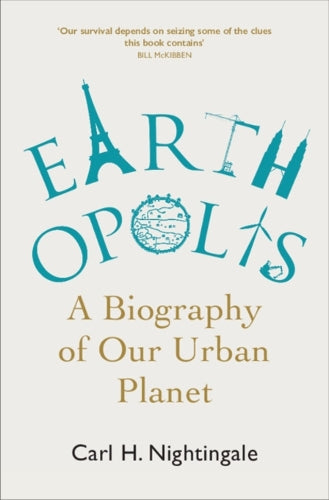
Earthopolis by Carl H Nightingale
This is a biography of Earthopolis, the only Urban Planet we know of. It is a history of how cities gave humans immense power over Earth, for good and for ill. Carl Nightingale takes readers on a sweeping six-continent, six-millennia tour of the world's cities, culminating in the last 250 years, when we vastly accelerated our planetary realms of action, habitat, and impact, courting dangerous new consequences and opening prospects for new hope. In Earthopolis we peek into our cities' homes, neighborhoods, streets, shops, eating houses, squares, marketplaces, religious sites, schools, universities, offices, monuments, docklands, and airports to discover connections between small spaces and the largest things we have built. The book exposes the Urban Planet's deep inequalities of power, wealth, access to knowledge, class, race, gender, sexuality, religion and nation. It asks us to draw on the most just and democratic moments of Earthopolis's past to rescue its future.
'Majestic in scale, full of fascinating detail about stones, bricks and systems of segregation, this book is charged with an urgency to create a new epic for our timesIt is nothing less than a new human history. Carl Nightingale will change how you think about where we come from, the places we live in, and the resources we consume from this planet and its sun.' Jeremy Adelman, author of Worldly Philosopher: the Odyssey of Albert O. Hirschman
'There's an exhilaration that comes with reading history written on this scale – much of our life that seems elusive or unconnected begins to make sense. And history is merely prelude to the future: on a planet of cities, our survival depends on seizing some of the clues this book contains.' Bill McKibben, author of Falter: Has the Human Game Begun to Play Itself Out
'Ours is the first century in which the majority of humankind lives in cities. Nightingale in this sprawling, imaginative, and clearly written book explains how we reached this point by exploring the political and ecological roles of cities in world history from ancient Mesopotamia to modern megalopoli.' J. R. McNeill, author of The Webs of Humankind
'Offer[s] a unique point of view that includes many valuable insights about cities …' David R. Conn, Library Journal
'There's an exhilaration that comes with reading history written on this scale – much of our life that seems elusive or unconnected begins to make sense. And history is merely prelude to the future: on a planet of cities, our survival depends on seizing some of the clues this book contains.' Bill McKibben, author of Falter: Has the Human Game Begun to Play Itself Out
'Ours is the first century in which the majority of humankind lives in cities. Nightingale in this sprawling, imaginative, and clearly written book explains how we reached this point by exploring the political and ecological roles of cities in world history from ancient Mesopotamia to modern megalopoli.' J. R. McNeill, author of The Webs of Humankind
'Offer[s] a unique point of view that includes many valuable insights about cities …' David R. Conn, Library Journal
Carl Nightingale has taught urban history and world history for 25 years as a Professor at the University at Buffalo and the University of Massachusetts. He is Coordinator of the Global Urban History Project, a network of over 500 scholars working in this new hybrid field. His book Segregation: A Global History of Divided Cities (2012) was co-winner of the Jerry Bentley Prize from the World History Association.
| SKU | Unavailable |
| ISBN 13 | 9781108424523 |
| ISBN 10 | 110842452X |
| Title | Earthopolis |
| Author | Carl H Nightingale |
| Condition | Unavailable |
| Binding Type | Hardback |
| Publisher | Cambridge University Press |
| Year published | 2022-06-09 |
| Number of pages | 814 |
| Cover note | Book picture is for illustrative purposes only, actual binding, cover or edition may vary. |
| Note | Unavailable |