


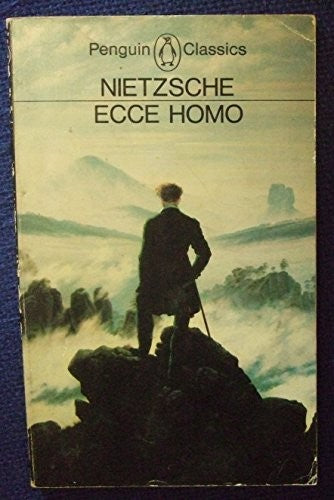
Ecce Homo by Friedrich Wilhelm Nietzsche
Ecce Homo, which is Latin for behold the man, is an autobiography like no other. Deliberately provocative, Nietzsche subverts the conventions of the genre and pushes his philosophical positions to combative extremes, constructing a genius-hero whose life is a chronicle of incessant self-overcoming. Written in 1888, a few weeks before his descent into madness, the book passes under review all of Nietzsche's previous works so that we, his posthumous readers, can finally understand him on his own terms. He reaches final reckonings with his many enemies, including Richard Wagner, German nationalism, modern men in general, and above all, Christianity, proclaiming himself the Antichrist. Ecce Homo is the summation of an extraordinary philosophical career, a last great testament to Nietzsche's will. A main purpose of the book was to offer Nietzsche's own perspective on his work as a philosopher and human being. Ecce Homo also forcefully repudiates those interpretations of his previous works purporting to find support there for imperialism, anti-Semitism, militarism, and social Darwinism. Nietzsche strives to present a new image of the philosopher and of himself as a philosopher. He expounds upon his life as a child, his tastes as an individual, and his vision for humanity. According to one of Nietzsche's most prominent English translators, Walter Kaufmann, this book offers Nietzsche's own interpretation of his development, his works, and his significance. Within this work, Nietzsche is self-consciously striving to present a new image of the philosopher and of himself. On these grounds, some consider Ecce Homo a literary work comparable in its artistry to Van Gogh's paintings.
Nietzsche, Friedrich Wilhelm: - Friedrich Nietzsche (1844-1900), German classical scholar, philosopher, and critic of culture, who became one of the most influential of all modern thinkers. His attempts to unmask the motives that underlie traditional Western religion, morality, and philosophy deeply affected generations of theologians, philosophers, psychologists, poets, novelists, and playwrights. He thought through the consequences of the triumph of the Enlightenment's secularism, expressed in his observation that God is dead, in a way that determined the agenda for many of Europe's most-celebrated intellectuals after his death. He was an ardent foe of nationalism, anti-Semitism, and power politics.
Nietzsche once wrote that some men are born posthumously, and that is certainly true in his case. The history of philosophy, theology, and psychology since the early 20th century is unintelligible without him. Nietzsche's great influence is due not only to his originality but also to the fact that he was one of the German language's most-brilliant prose writers.
| SKU | Unavailable |
| ISBN 13 | 9780140443936 |
| ISBN 10 | 0140443932 |
| Title | Ecce Homo |
| Author | Friedrich Wilhelm Nietzsche |
| Series | Penguin Classics S |
| Condition | Unavailable |
| Binding Type | Paperback |
| Publisher | Penguin Books Ltd |
| Year published | 1979-04-26 |
| Number of pages | 144 |
| Cover note | Book picture is for illustrative purposes only, actual binding, cover or edition may vary. |
| Note | Unavailable |