


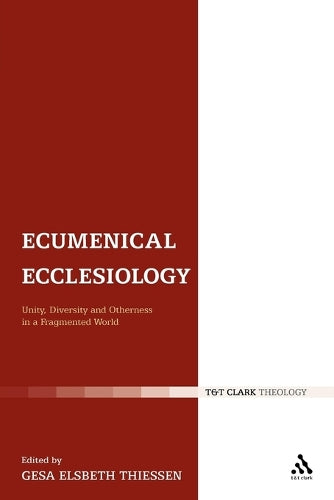
Ecumenical Ecclesiology by Gesa Elsbeth Thiessen
This is a rich collection of fifteen articles by European, North American and Asian theologians who are concerned with the concept, life, unity and future of the church. It offers a wealth of broad perspectives on ecclesiology by scholars from Catholic, Protestant and Orthodox backgrounds. The first section, Perspectives on Ecumenical Ecclesiology, comprises reflections on postmodern ecclesiologies as well as on the development and problems concerning ecumenical methods and models of unity. The second section, Communion Ecclesiology and Otherness, provides some pertinent deliberations on how an ecclesiology of communion can integrate otherness. In particular, Zizioulas communion ecclesiology is critically examined, the possibility for a retrieval of Eucharistic theology between Catholics and Orthodox is put forward, and Tillard's communion ecclesiology is appraised as offering resources for innerdenominational otherness. The final section, Ecclesiology in Global Contexts, considers critically the possibility of evangelical ecclesiology as an answer to ethnic impaired Christian community. The role of the (Catholic) Church and its values in Europe and vis--vis the European Constitution is examined. The Church of Nigeria's Constitutional Revision (2005) and its ecclesial- ecumenical implications comes into focus, and three notable concepts of unity, as developed by three Indian scholars, S.K. George, John Sadiq and Karem David, are evaluated. Finally, the Japanese diaspora in the States is appraised as a place where a particular Japanese Christian vision could emerge through the internationalist ecclesiology developed by Japanese Christian missionaries.
Guided by an editor at once theologically critical and ecumenically compassionate, these authors follow her lead in bringing historically informed theory to bear on the contemporary contexts and practices of ecclesial bodiesThe volume delivers what the best of such collections achieve: a range of provocative questions sure to incite further academic inquiry with confidence and newfound ecumenical purpose. -- Bruce T. Morrill, Boston College, Chestnut Hill, Massachusetts, USA
Those with a serious interest in theology, but who think that ecumenism has become a boring and interminable debate among clerics, will be pleasantly surprised by this volume. It shows that internal divisions, especially in the Roman Catholic Church and the Anglican Communion, have now reached the stage of ecumenical problems in their own right, though in both cases the resources are there to tackle them. New light is shed on ‘communion' ecclesiology in Orthodoxy and the sharp disagreements to which it gives rise. Running through these more classical themes are the tensions caused by gender, ethnicity and inculturation, with striking examples from Korea and Japan. Starting from the core notion of the ecumenical, the book exemplifies its relevance to a wide range of contemporary issues. -- John D'Arcy May, Irish School of Ecumenics, Trinity College Dublin, Ireland
Ecumenical Ecclesiology is a useful and insightful guide through the complex contemporary debate on how the church could be one without losing its many faces and particularities. It offers a rich variety of contributions from diverse denominational and cultural backgrounds committed to the re-evaluation of older models of ecumenism while sharing their desire for the church's celebration, witness and service in the world not to be disrupted by divisions. -- Ivana Noble, Protestant Theological Faculty, Charles University of Prague, Czech Republic
The idea for the volume was kicked around at various international conferences on religion during the years leading up to the centenary of the 1910 World Missionary Conference, which is recognized as the birth of the modern ecumenical movement. Theologians from Europe and the US offer perspectives on contemporary ecumenical ecclesiology, communion ecclesiology and otherness, and ecclesiology in global contexts. Among their topics are reflecting on methods in contemporary ecumenical dialogues, theological resources for divided denominations, questions of ecclesial and divine communion, retrieving eucharistic ecclesiology, instruments of faith and unity in canon law in the Church of Nigeria constitutional revision of 2005, and the ecclesiological matrix of Japanese Christian activists in Japan and the US diaspora. -- Eithne O'Leyne * BOOK NEWS, Inc. *
The essays vary widely in accessibility, style and scope, though the quality is high. They seek not to provide a single coherent perspective but to showcase the range of thinking from those who believe that serious study of ecclesiology can change the shape both of the Church's internal divisions and of its contribution to dangerously fragmented world. In that they succeed. -- David Goodbourn * Baptist Quarterly *
Those with a serious interest in theology, but who think that ecumenism has become a boring and interminable debate among clerics, will be pleasantly surprised by this volume. It shows that internal divisions, especially in the Roman Catholic Church and the Anglican Communion, have now reached the stage of ecumenical problems in their own right, though in both cases the resources are there to tackle them. New light is shed on ‘communion' ecclesiology in Orthodoxy and the sharp disagreements to which it gives rise. Running through these more classical themes are the tensions caused by gender, ethnicity and inculturation, with striking examples from Korea and Japan. Starting from the core notion of the ecumenical, the book exemplifies its relevance to a wide range of contemporary issues. -- John D'Arcy May, Irish School of Ecumenics, Trinity College Dublin, Ireland
Ecumenical Ecclesiology is a useful and insightful guide through the complex contemporary debate on how the church could be one without losing its many faces and particularities. It offers a rich variety of contributions from diverse denominational and cultural backgrounds committed to the re-evaluation of older models of ecumenism while sharing their desire for the church's celebration, witness and service in the world not to be disrupted by divisions. -- Ivana Noble, Protestant Theological Faculty, Charles University of Prague, Czech Republic
The idea for the volume was kicked around at various international conferences on religion during the years leading up to the centenary of the 1910 World Missionary Conference, which is recognized as the birth of the modern ecumenical movement. Theologians from Europe and the US offer perspectives on contemporary ecumenical ecclesiology, communion ecclesiology and otherness, and ecclesiology in global contexts. Among their topics are reflecting on methods in contemporary ecumenical dialogues, theological resources for divided denominations, questions of ecclesial and divine communion, retrieving eucharistic ecclesiology, instruments of faith and unity in canon law in the Church of Nigeria constitutional revision of 2005, and the ecclesiological matrix of Japanese Christian activists in Japan and the US diaspora. -- Eithne O'Leyne * BOOK NEWS, Inc. *
The essays vary widely in accessibility, style and scope, though the quality is high. They seek not to provide a single coherent perspective but to showcase the range of thinking from those who believe that serious study of ecclesiology can change the shape both of the Church's internal divisions and of its contribution to dangerously fragmented world. In that they succeed. -- David Goodbourn * Baptist Quarterly *
Gesa Thiessen is a lecturer at Milltown Institute of Theology and Philosophy in Dublin and an Honorary Research Fellow at the Department of Theology and Religious Studies at the University of Wales, Lampeter. She is a member of the steering group of the Ecclesiological Investigations International Research Network.
| SKU | Unavailable |
| ISBN 13 | 9780567618344 |
| ISBN 10 | 056761834X |
| Title | Ecumenical Ecclesiology |
| Author | Gesa Elsbeth Thiessen |
| Series | Ecclesiological Investigations |
| Condition | Unavailable |
| Binding Type | Paperback |
| Publisher | Bloomsbury Publishing PLC |
| Year published | 2011-02-24 |
| Number of pages | 260 |
| Cover note | Book picture is for illustrative purposes only, actual binding, cover or edition may vary. |
| Note | Unavailable |