


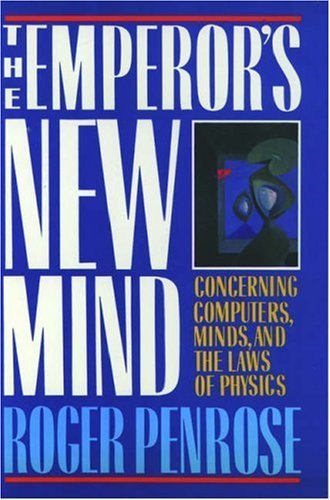
The Emperor's New Mind by Roger Penrose
The proponents of artificial intelligence want to prove that it is only a matter of time before computers will be doing everything that a human mind can do. They take it for granted that pleasure and pain, the appreciation of beauty and humour, consciousness and free will are capacities that a computer will display once the appropriate programs of algorithms have been developed. Some disagree, because although electronic computers can calculate very rapidly, that does not make them understand what they are doing any more than, for example, an abacus does. The author puts forward his view that there is some facet of human thinking that can never be emulated by a machine. He shows the physical and mathematical ideas that are the background to his argument - from Turing machines, algorithms and the Chinese room, via quantum mechanics, cosmology and relativity to the structure of the brain, inspiration and consciousness itself.Sir Roger Penrose is renowned for his significant contributions to mathematical physics, in particular general relativity and cosmology. Currently Emeritus Rouse Ball Professor of Mathematics at the University of Oxford and Emeritus Fellow of Wadham College, he earned his Ph.D. in mathematics from the University of Cambridge in 1957, before being appointed Research Fellow at St. John's College, Cambridge. He then spent time at Princeton and Syracuse University before returning to the UK as a research associate at King's College, London, which was quickly followed by a further stint in the U.S. at the University of Texas at Austin. He then returned to the UK to Birkbeck College, London, where he eventually became Professor of Applied Mathematics. In 1973, he was appointed Rouse Ball Professor of Mathematics at the University of Oxford, earning the status Emeritus Professor in 1998. In the same year, he was also appointed Gresham Professor of Geometry at Gresham College, London. Penrose has been awarded numerous honors for his scientific contributions: in 1975 with Stephen Hawking he was awarded the Eddington Medal of the Royal Astronomical Society, and in 1988 Penrose and Hawking were awarded the Wolf Prize in Physics for their development of the theory of general relativity. In 1985, Penrose received the Royal Society's Royal Medal and in 1989 he was honored with the Dirac Medal and Prize of the British Institute of Physics. In 1990, he received the Albert Einstein Medal, followed by the Naylor Prize of the London Mathematical Society in 1991, and the DeMorgan Medal for his wide and original contributions to mathematical physics in 2004. A Fellow of the Royal Society of London since 1972, Penrose was elected Foreign Associate of the U.S. National Academy of Sciences in 1998 and in 1994 he was knighted for services to science.
| SKU | Unavailable |
| ISBN 13 | 9780198519737 |
| ISBN 10 | 0198519737 |
| Title | The Emperor's New Mind |
| Author | Roger Penrose |
| Condition | Unavailable |
| Binding Type | Paperback |
| Publisher | Oxford University Press |
| Year published | 1989-10-05 |
| Number of pages | 479 |
| Prizes | Winner of Science Book Award 1990 |
| Cover note | Book picture is for illustrative purposes only, actual binding, cover or edition may vary. |
| Note | Unavailable |