


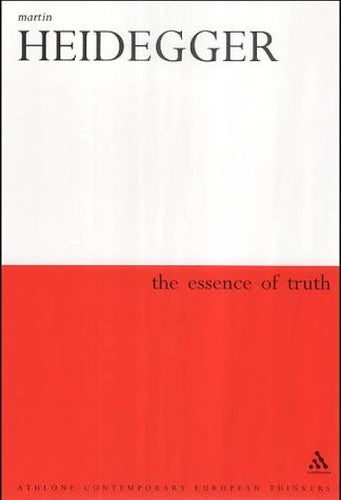
The Essence of Truth by Martin Heidegger
One of Heidegger's most important works, this text gives a thorough explanation of what is arguably the most fundamental and abiding theme of his philosophy, namely the difference between truth as the "unhiddenness of beings" and truth as the "correctness of propositions". For Heidegger, it was by neglecting the former primordial concept of truth in favour of the latter derivative concept that Western philosophy, beginning with Plato himself, took off on its "metaphysical" course towards the bankruptcy of the present day. This book consists of a lecture course delivered by Heidegger at the University of Freiburg in 1931-32. The first part is a detailed analysis of Plato's "Allegory of the Cave" in "The Republic", while the second part gives an exegesis and interpretation of a central section of Plato's "Theaetetus". As always with Heidegger's writings on the Greeks, the point of his interpretative method is to bring to light the original meaning of philosophical concepts, especially to free up these concepts to their intrinsic power.
Martin Heidegger (1889-1976) is now regarded as one of the twentieth century's most important philosophers. The translator, Dr Ted Sadler, studied at the University of Sydney and has taught philosophy widely at Australian universities.
| SKU | Unavailable |
| ISBN 13 | 9780826459220 |
| ISBN 10 | 0826459226 |
| Title | The Essence of Truth |
| Author | Martin Heidegger |
| Series | Athlone Contemporary European Thinkers S |
| Condition | Unavailable |
| Binding Type | Paperback |
| Publisher | Bloomsbury Publishing PLC |
| Year published | 2002-05-01 |
| Number of pages | 304 |
| Cover note | Book picture is for illustrative purposes only, actual binding, cover or edition may vary. |
| Note | Unavailable |