


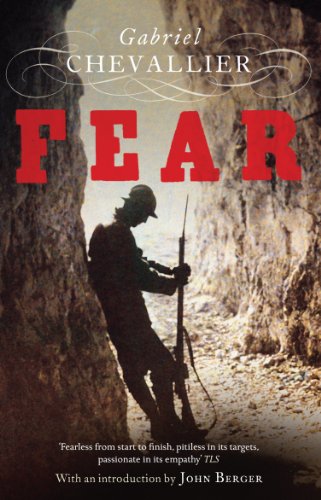
Fear by Gabriel Chevallier
It is 1915. Jean Dartemont is just a young man. He is not a rebel, but neither is he awed by authority and when he's called up and given only the most rudimentary training, he refuses to follow his platoon. Instead, he is sent to Artois, where he experiences the relentless death and violence of the trenches. His reprieve finally comes when he is wounded, evacuated and hospitalised. The nurses consider it their duty to stimulate the soldiers' fighting spirit, and so ask Jean what he did at the front. His reply? 'I was afraid.' First published in France in 1930, Fear is both graphic and clear-eyed in its depiction of the terrible experiences of soldiers during the First World War.
Gabriel Chevallier, best known for his magnificent novel Clochemerle, has used his experiences during World War I to produce a work of great intensity, comparable to such great literary masterpieces of the period as Henri Barbusse's Under Fire * Daily Mail *
There are enough flashes of intense colour and incident to make this translation a worthwhile exercise -- Toby Clements * Sunday Telegraph *
Chevallier's pen is as sharp as a bayonet in exposing the arrogance and stupidity of commanding officers.. The power of the novel is increased by deft variations of pace ... There are eloquent soliloquies on nationalism and individual liberty, and impassioned arguments on the nature of war and its effects on those who wage it, by the only men truly qualified to speak of them ... Fear is being billed as a French All Quiet on the Western Front, and in this fine translation by Malcolm Imrie it is a fair claim -- Gavin Bell * Herald *
One of the most affective indictments of war ever written -- Tobias Grey * Bookself *
The most beautiful book ever written on the tragic events that blood-stained Europe for nearly five years ... a classic * Le Libertaire *
All the horrors of war are there, but atrocity alone would not be enough to explain the grandeur of this text. It is the healthy defiance and controlled anger which earned the book its stripes * Le Figaro *
It is the fear of the condemned man that is described here: fear that sometimes paralyses and sometimes excites by separating strength from courage. These pages which would have had the author shot during the war, we read them with amazement brought on by their complete honesty * Le Soir *
What Chevallier wanted to write with Fear is a straightforward, honest book, from which all artifice is absent; a work that gives the reader the exact measure of war. Chevallier has had the courage to strip war of all its prestige by admitting: I was frightened * Liberté *
A bravura work, fearless from start to finish, pitiless in its targets, passionate in its empathy * TLS *
Visceral, brutal * TLS *
There are enough flashes of intense colour and incident to make this translation a worthwhile exercise -- Toby Clements * Sunday Telegraph *
Chevallier's pen is as sharp as a bayonet in exposing the arrogance and stupidity of commanding officers.. The power of the novel is increased by deft variations of pace ... There are eloquent soliloquies on nationalism and individual liberty, and impassioned arguments on the nature of war and its effects on those who wage it, by the only men truly qualified to speak of them ... Fear is being billed as a French All Quiet on the Western Front, and in this fine translation by Malcolm Imrie it is a fair claim -- Gavin Bell * Herald *
One of the most affective indictments of war ever written -- Tobias Grey * Bookself *
The most beautiful book ever written on the tragic events that blood-stained Europe for nearly five years ... a classic * Le Libertaire *
All the horrors of war are there, but atrocity alone would not be enough to explain the grandeur of this text. It is the healthy defiance and controlled anger which earned the book its stripes * Le Figaro *
It is the fear of the condemned man that is described here: fear that sometimes paralyses and sometimes excites by separating strength from courage. These pages which would have had the author shot during the war, we read them with amazement brought on by their complete honesty * Le Soir *
What Chevallier wanted to write with Fear is a straightforward, honest book, from which all artifice is absent; a work that gives the reader the exact measure of war. Chevallier has had the courage to strip war of all its prestige by admitting: I was frightened * Liberté *
A bravura work, fearless from start to finish, pitiless in its targets, passionate in its empathy * TLS *
Visceral, brutal * TLS *
Gabriel Chevallier was best known for his satirical novel, Clochemerle, which was first published in 1934, subsequently translated into twenty-six languages, and went on to sell several million copies. Born in Lyon, Chevallier was called up at the start of the First World War and wounded a year later. He later returned to the front where he served as an infantryman until the war's end. He was awarded the Croix de Guerre and Chevalier de la Legion d'Honneur. La Peur (Fear), which was first published in 1930, draws upon his own experiences and forms a damning indictment of the war. Chevallier died in 1969. Serpent's Tail published the paperback original [9781846687266].
| SKU | Unavailable |
| ISBN 13 | 9781846687273 |
| ISBN 10 | 1846687276 |
| Title | Fear |
| Author | Gabriel Chevallier |
| Condition | Unavailable |
| Binding Type | Paperback |
| Publisher | Profile Books Ltd |
| Year published | 2012-11-01 |
| Number of pages | 320 |
| Prizes | Winner of The Scott Moncrieff Prize 2013 (UK) |
| Cover note | Book picture is for illustrative purposes only, actual binding, cover or edition may vary. |
| Note | Unavailable |