


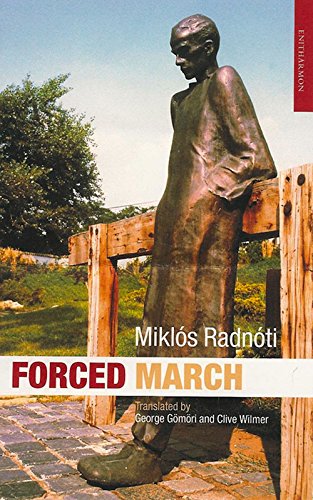
Forced March by Clive Wilmer
Forced March is a new edition of Radnoti s selected poems, in the powerful and moving translations of Clive Wilmer and George Gomori. Poet Dick Davis explains why this book is so important: Radnoti has emerged as the major poetic voice to record the civilian experience of World War I in occupied Europe. His poems are an extraordinary record of a mind determined to affirm its civilization in the face of overwhelming odds. He is one of the very greatest poets of the twentieth century, and Clive Wilmer s and George Gomori s versions are by far the best that exist in English. By the time the Second World War broke out, Miklos Radnoti was already an established poet. When the Nazis took over his home-town of Budapest, Radnoti was sent to a labour camp at Bor in occupied Serbia. Then, in 1944, as the Germans retreated from the eastern front, Radnoti and his fellow labourers were force-marched back into Hungary. On 9 November, too weak to carry on, he and many comrades were executed by firing-squad. When the bodies were exhumed the following year, Radnoti was identified by a notebook of poems in his greatcoat pocket. These poems, published in 1946 as Foaming Sky, secured his position as one of the giants of modern Hungarian poetry.Miklos Radnoti was born in Budapest in 1909, and is considered one of the titans of modern Hungarian poetry. He was of Jewish ancestry. He was orphaned at a young age and had little emotional security until his 1935 marriage to Fanni Gyarmati, the poet's muse. His first collection of poetry, A Pagan Welcome, was released when he was 21 years old, in 1930. It consists of innocent, formless, and avant-garde celebrations of life and love.
Subsequent chapters demonstrate the impact of libertarian Socialism, followed by Roman Catholicism. Radnoti's true genius, however, does not emerge until his sixth work, Keep Walking, You, the Death-Condemned (1936), where it is centered on his growing fear over fascism's ascent. This work, as well as Steep Road (1938), reveal his developing interest in fate and the deaths of young poets. The first two of his eclogues in classical meters are included in the latter.
With Hungary under the shadow of the Third Reich from 1940 onwards, Radnoti, like many other Jews, was forced to serve in forced labor battalions. As the Germans retreated from the eastern front, the last of these, at Bor in Serbia, was evacuated in 1944. Radnoti and his fellow laborers were forcibly returned to Hungary, where, too weak to continue, he and many of his compatriots were killed by firing squad on November 9th. The bodies were exhumed the next year.
A notebook of poems in Radnotis' greatcoat pocket identified him. Foaming Skies was the title given to them when they were first published in 1946.
| SKU | Unavailable |
| ISBN 13 | 9781900564533 |
| ISBN 10 | 190056453X |
| Title | Forced March |
| Author | Clive Wilmer |
| Condition | Unavailable |
| Binding Type | Paperback |
| Publisher | Enitharmon Press |
| Year published | 2003-08-01 |
| Number of pages | 80 |
| Cover note | Book picture is for illustrative purposes only, actual binding, cover or edition may vary. |
| Note | Unavailable |