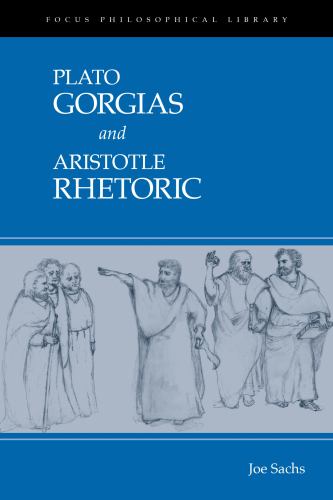
Gorgias and Rhetoric by Plato

Gorgias and Rhetoric by Plato

Regular price
Checking stock...
Regular price
Checking stock...
The feel-good place to buy books
  • Free UK delivery over £5
  • 10% off preloved books when you join +Plus
  • Buying preloved emits 46% less CO2 than new
  • Give your books a new home - sell them back to us!

Gorgias and Rhetoric by Plato

By pairing translations of Gorgias and Rhetoric, along with an outstanding introductory essay, Joe Sachs demonstrates Aristotles response to Plato. If in the Gorgias Plato probes the question of what is problematic in rhetoric, in Rhetoric, Aristotle continues the thread by looking at what makes rhetoric useful. By juxtaposing the two texts, an interesting "conversation" is illuminated--one which students of philosophy and rhetoric will find key in their analytical pursuits.

Focus Philosophical Library translations are close to and are non-interpretative of the original text, with the notes and a glossary intending to provide the reader with some sense of the terms and the concepts as they were understood by Aristotle and Plato's immediate audience.

ARISTOTLE was born in the northern Greek town of Stagira in 384 B.C.E., where his father was the personal physician to the great-grandfather of Alexander the Great. At the age of eighteen Aristotle entered Plato's Academy and soon became recognized as its most important student. He remained under Plato's tutelage for nearly twenty years.

After his teacher's death in 347 B.C.E., Aristotle cultivated associations with other Academy students throughout Greece and Asia Minor. Then in 342 B.C.E., Aristotle was asked by King Philip II of Macedonia to become the tutor for his young son Alexander, who was later to become the conqueror of much of the known world at that time. The young prince remained under Aristotle's supervision until 336 B.C.E., when he acceded to the throne after his father's death. Two years later Aristotle returned to Athens and founded his own school, which he called the Lyceum. This intellectual center flourished during the years when Alexander the Great ruled Greece as part of his large empire. But upon Alexander's death in 323 B.C.E., Aristotle was charged with impiety by Athenians who resented his associations with the Macedonian conqueror. Rather than risk the same fate as Plato's mentor, Socrates, Aristotle fled to the city of Chalcis, where he died in 322 B.C.E.

Aristotle's interests, like those of Plato, were diverse and his writing cast its shadow on many fields, including logic, metaphysics, epistemology, ethics, politics, and the sciences. Among his most well-known works are: The Categories, The Prior and Posterior Analytics, The Physics, The Meta-physics, De Anima, The Nicomachean Ethics, and The Politics.

SKU Unavailable
ISBN 13 9781585102990
ISBN 10 1585102997
Title Gorgias and Rhetoric
Author Plato
Series Focus Philosophical Library
Condition Unavailable
Binding Type Paperback
Publisher Focus Publishing/R Pullins & Co
Year published 2008-10-15
Number of pages 298
Cover note Book picture is for illustrative purposes only, actual binding, cover or edition may vary.