


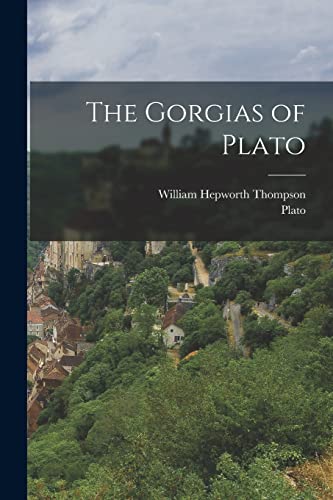
The Gorgias of Plato by Plato
With a masterful sense of the place of rhetoric in both thought and practice and an ear attuned to the clarity, natural simplicity, and charm of Plato's Greek prose, James H. Nichols, Jr., offers a precise yet unusually readable translation of one of the great Platonic dialogues on rhetoric. The Gorgias presents an intransigent argument that justice is superior to injustice--to the extent that suffering an injustice is preferable to committing an unjust act. The dialogue contains some of Plato's most significant and famous discussions of major political themes, and focuses dramatically and with unrivaled intensity on Socrates as a political thinker and actor. Nichols's attention to dramatic detail brings this dialogue to life. Plato's striking variety in conversational address (names and various terms of relative warmth and coolness) is carefully reproduced, as is alteration in tone and implication even in the short responses. The translation renders references to the gods accurately and non-monotheistically for the first time, and includes a fascinating variety of oaths and invocations. Nichols believes that Plato's thought on rhetoric has been largely misunderstood, and he uses his translation as an opportunity to reconstruct the classical position on right relations between thought and public activity.
Born to a politically connected and aristocratic family between 428 and 423 B.C., Plato received a good standard of education at an early age, and was able to immerse himself in the intellectual community of Ancient Athens. His most notable contemporary and mentor was Socrates, an eccentric but highly capable philosopher who was to feature as a principle character in most of Plato's scholarly writings. Owing to his high standard of education in art, mathematics, rhetoric and philosophy, Plato was able to assemble a comprehensive philosophy of his own via his favoured form of writing which was the dialogue. In total, over thirty of these Platonic dialogues have survived the passage of time - and together they form the backbone of Ancient Greek philosophy. After enjoying success as a writer and academic, Plato in 385 B.C. founded The Academy. This school was to unite the most capable thinkers of Greece, and would help to advance learning throughout Greek society's Golden Age. It was in the Academy that Plato would instruct and apprentice Aristotle, who was to go on to gain renown as a philosopher and scholar. Owing to his reputation Plato was hired by Dion, whose nephew Dionysus II was the rightful ruler of Sicily - Dion wished his nephew to receive a good education in the art of sound and wise governance. However Dionysus II became suspicious and accused both Plato and Dion of conspiracy - after some time spent under arrest, Plato returned to his homeland. In his late period, Plato continued to tutor and mentor the best young minds of Athens, and he would perish around 348 B.C. having lived beyond the age of eighty. Today Plato's legacy remains lauded: the philosopher ably used logic and reason to imbue insight on democratic governance, while developing a cohesive philosophy on topics such as art, metaphysics, justice and the 'Theory of Forms' - his iconic take on how ideas related to reality.
| SKU | Unavailable |
| ISBN 13 | 9781016690768 |
| ISBN 10 | 1016690762 |
| Title | The Gorgias of Plato |
| Author | Plato |
| Condition | Unavailable |
| Binding Type | Paperback |
| Publisher | Legare Street Press |
| Year published | 2022-10-27 |
| Number of pages | 276 |
| Cover note | Book picture is for illustrative purposes only, actual binding, cover or edition may vary. |
| Note | Unavailable |