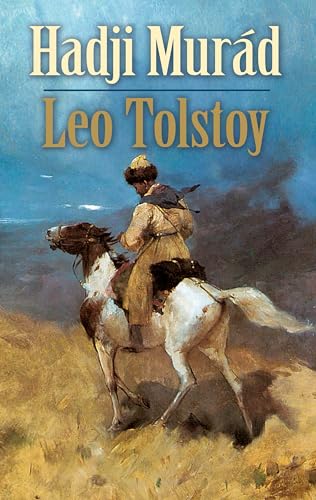
Hadji Murad
Hadji Murad
The feel-good place to buy books
- Free UK delivery over £5
- 10% off preloved books when you join +Plus
- Buying preloved emits 46% less CO2 than new
- Give your books a new home - sell them back to us!

Hadji Murad by Count Leo Nikolayevich Tolstoy
Near the end of his long life, in 1904, he wrote yet another story of the Caucasus, an area he knew from his own military experiences there in his twenties (the 1850s), participating in incursions into the Caucasus area. The Russian long-term strategy in the Caucacus had developed into a continuing effort to unite Orthodox Christian Russia itself with the Christian nation of Georgia. The area in between, however, had long been settled by various ethnic groups of the Muslim faith, often at odds with each other, among which were the Chechens. This story, though told as fiction, is about a real Chechen leader, a cultural hero (dzhigit), Hadji Murad, who had been active at the time. Tolstoy seems artless in the infectious spirit of life in his writings. He himself questioned this quality in What Is Art? Curiosity and keen observation and, in this case, good memory, serve him well. His ability to inhabit his characters, including those of another culture, may rival that ability in Shakespeare, so that we readers feel that we know the characters and the world they inhabit as well as the author does. Brief history lesson: This episode occurs right between two important European events: the revolutions of 1848, and the Crimea War. A Glossary is provided, including notes on historical events and personalities of the times. Another book by Tolstoy, not a novel, is The Gospel According to Tolstoy (www.createspaced.com/3846726), a reweaving of the Gospel stories of Jesus to uncover his teaching, while rejecting the non-teaching elements: the miracle birth, genealogy, miracles, resurrection, claim for his messiahship. Tolstoy distills the teaching to five new commandments.Near the end of his long life, in 1904, he wrote yet another story of the Caucasus, an area he knew from his own military experiences there in his twenties (the 1850s), participating in incursions into the Caucasus area. The Russian long-term strategy in the Caucacus had developed into a continuing effort to unite Orthodox Christian Russia itself with the Christian nation of Georgia. The area in between, however, had long been settled by various ethnic groups of the Muslim faith, often at odds with each other, among which were the Chechens. This story, though told as fiction, is about a real Chechen leader, a cultural hero (dzhigit), Hadji Murad, who had been active at the time. Tolstoy seems artless in the infectious spirit of life in his writings. He himself questioned this quality in What Is Art? Curiosity and keen observation and, in this case, good memory, serve him well. His ability to inhabit his characters, including those of another culture, may rival that ability in Shakespeare, so that we readers feel that we know the characters and the world they inhabit as well as the author does. Brief history lesson: This episode occurs right between two important European events: the revolutions of 1848, and the Crimea War. A Glossary is provided, including notes on historical events and personalities of the times. Another book by Tolstoy, not a novel, is The Gospel According to Tolstoy (www.createspaced.com/3846726), a reweaving of the Gospel stories of Jesus to uncover his teaching, while rejecting the non-teaching elements: the miracle birth, genealogy, miracles, resurrection, claim for his messiahship. Tolstoy distills the teaching to five new commandments.
| SKU | Unavailable |
| ISBN 13 | 9780486473666 |
| ISBN 10 | 048647366X |
| Title | Hadji Murad |
| Author | Leo Tolstoy |
| Condition | Unavailable |
| Binding Type | Paperback |
| Publisher | Dover Publications Inc. |
| Year published | 2010-02-26 |
| Number of pages | 160 |
| Cover note | Book picture is for illustrative purposes only, actual binding, cover or edition may vary. |
| Note | Unavailable |