


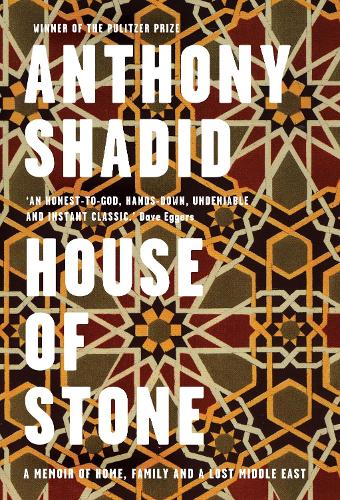
House of Stone by Anthony Shadid
In spring 2011, Anthony Shadid was one of four New York Times reporters captured in Libya, cuffed and beaten, as that country was seized by revolution. When he was freed, he went home. Not to Boston or Beirut where he lived or to Oklahoma City, where his Lebanese-American family had settled. Instead, he returned to his great-grandfather's estate in Lebanon, a house that, over three years earlier, Shadid had begun to rebuild. House of Stone is the story of a battle-scarred home and a war correspondent's jostled spirit, and of how reconstructing the one came to fortify the other. Shadid creates a mosaic of past and present, tracing the house's renewal alongside his family's flight from Lebanon and resettlement in America. He memorializes a lost world and provides profound insights into this volatile landscape. House of Stone is an unforgettable meditation on war, exile, rebirth and the universal yearning for home.
Six pages into this book, I said to myself, if Shadid continues like this, this book will be a classicAnd page by page, he did continue -- Dave Eggers, author * Zeitoun *
There is not space here to set out all of this book's many rewards... The prose is ripe, the biblical landscapes vividly rendered... Profound, insightful, tragic and funny... House of Stone will stand a long time, for those fortunate enough to read it -- Ed Loughlin * Daily Telegraph *
The insights into life in war-ravaged southern Lebanon make for a powerful read, at once a personal memoir and a sweeping regional analysis -- Josh Glancey * Sunday Times *
Encapsulates [Shadid's] yearning for a home, and for the rehabilitation of his soul, after years spent documenting the horror of war -- Arifa Akbar, Books of the Year * Independent *
Offers a powerful reminder of the impact that never-ending insecurity has on people long after the violence that ruined their lives has been forgotten by the rest of the world * New York Times *
One of the finest memoirs I've read * Washington Post *
House of Stone takes the reader to the heart of the Middle East and all its conflicts: the core question of what gives people a sense of who they are and what they are * Newsweek *
Illuminating and distinctive, a living blueprint of a work of rescue and commemoration... that does its delineator proud -- George O’Brien * Irish Times *
A poetic but pragmatic memoir... His book a fine tribute to his family heritage and to the life of Shadid himself -- Iain Finlayson * The Times Saturday Review *
An unforgettable meditation on war, exile and yearning for home * Vogayer Magazine *
Sober and intelligent... a thoughtful meditation on diaspora identity and an elegy to a once-cosmopolitan Ottoman past... This fine book stands as a fitting and poignant memorial to a remarkable journalist -- William Dalrymple * Financial Times *
Magnificent... Its brilliance lies in its several layers of content, as expressed by a masterly writer. Shadid breaks from his feuds with recalcitrant electricians and tilers to tell the story of his own family's travails in both Lebanon and America, and therefore of the 20th-century Levantine diaspora -- Roger Hutchinson * Scotsman *
[A] memorable book that delights with a cast of eccentric characters who would be equally at home in a Dickens novel or in the works of the Egyptian writer Alaa Al Aswany -- Michael Williams * The World Today *
[Shadid] had a poetic style, and he set out to change the way the American press writes about Arabs... We should cherish Shadid's vision of tolerance and openness -- Alan Philips * The National *
[A] heartbreakingly good book -- Jonathan Rugman * Spectator *
Interwoven with his own experiences, Shadid recreates his family's migration to 1920s Oklahoma, vividly imagining their alienation as they adapted to a new culture -- Lucy Popescu * Independent *
Shadid writes lucidly, mixing elements of the lyricism and allusiveness of Arabic prose with Chandleresque American -- Tim Llewellyn * Times Literary Supplement *
There is not space here to set out all of this book's many rewards... The prose is ripe, the biblical landscapes vividly rendered... Profound, insightful, tragic and funny... House of Stone will stand a long time, for those fortunate enough to read it -- Ed Loughlin * Daily Telegraph *
The insights into life in war-ravaged southern Lebanon make for a powerful read, at once a personal memoir and a sweeping regional analysis -- Josh Glancey * Sunday Times *
Encapsulates [Shadid's] yearning for a home, and for the rehabilitation of his soul, after years spent documenting the horror of war -- Arifa Akbar, Books of the Year * Independent *
Offers a powerful reminder of the impact that never-ending insecurity has on people long after the violence that ruined their lives has been forgotten by the rest of the world * New York Times *
One of the finest memoirs I've read * Washington Post *
House of Stone takes the reader to the heart of the Middle East and all its conflicts: the core question of what gives people a sense of who they are and what they are * Newsweek *
Illuminating and distinctive, a living blueprint of a work of rescue and commemoration... that does its delineator proud -- George O’Brien * Irish Times *
A poetic but pragmatic memoir... His book a fine tribute to his family heritage and to the life of Shadid himself -- Iain Finlayson * The Times Saturday Review *
An unforgettable meditation on war, exile and yearning for home * Vogayer Magazine *
Sober and intelligent... a thoughtful meditation on diaspora identity and an elegy to a once-cosmopolitan Ottoman past... This fine book stands as a fitting and poignant memorial to a remarkable journalist -- William Dalrymple * Financial Times *
Magnificent... Its brilliance lies in its several layers of content, as expressed by a masterly writer. Shadid breaks from his feuds with recalcitrant electricians and tilers to tell the story of his own family's travails in both Lebanon and America, and therefore of the 20th-century Levantine diaspora -- Roger Hutchinson * Scotsman *
[A] memorable book that delights with a cast of eccentric characters who would be equally at home in a Dickens novel or in the works of the Egyptian writer Alaa Al Aswany -- Michael Williams * The World Today *
[Shadid] had a poetic style, and he set out to change the way the American press writes about Arabs... We should cherish Shadid's vision of tolerance and openness -- Alan Philips * The National *
[A] heartbreakingly good book -- Jonathan Rugman * Spectator *
Interwoven with his own experiences, Shadid recreates his family's migration to 1920s Oklahoma, vividly imagining their alienation as they adapted to a new culture -- Lucy Popescu * Independent *
Shadid writes lucidly, mixing elements of the lyricism and allusiveness of Arabic prose with Chandleresque American -- Tim Llewellyn * Times Literary Supplement *
ANTHONY SHADID was a foreign correspondent for the New York Times and former Baghdad bureau chief of the Washington Post. Over a fifteen-year career, he reported from most countries in the Middle East. He won his first Pulitzer Prize in 2004 for his coverage of the US invasion and occupation of Iraq. He won a second in 2010. Shadid is the author of Legacy of the Prophet: Despots, Democrats and the New Politics of Islam (2001), and Night Draws Near: Iraq's People in the Shadow of America's War (2005), which was a finalist for the National Book Critics Circle Award. Shadid died of an asthma attack while attempting to leave Syria on horseback in February 2012.
| SKU | Unavailable |
| ISBN 13 | 9781847087362 |
| ISBN 10 | 1847087361 |
| Title | House of Stone |
| Author | Anthony Shadid |
| Condition | Unavailable |
| Binding Type | Paperback |
| Publisher | Granta Books |
| Year published | 2013-03-07 |
| Number of pages | 336 |
| Prizes | Short-listed for National Book Award 2012 (UK), Short-listed for National Book Critics Circle Award 2013 (UK) |
| Cover note | Book picture is for illustrative purposes only, actual binding, cover or edition may vary. |
| Note | Unavailable |